
Hendersonville TN Tree Removal provides arborist inspections and written tree risk assessments across Hendersonville, TN, serving surrounding cities including Mount Juliet, Oak Hill, La Vergne, Forest Hills and Brentwood. More than 20 years of climbing, rigging and grinding in Middle Tennessee is what stands behind the reports — we write about failures we have been called out to clean up, on the same soils and the same species.
An assessment is a different product from a removal quote. It is a document written to be handed to somebody: a neighbor who does not believe the tree is dangerous, an HOA board that needs a reason, an insurance adjuster deciding what to pay, or a planning reviewer who wants the dead-or-dying question answered by someone qualified to answer it. That means the evidence has to be on the page, not in our heads.
It also means we say no. A large share of the trees we are asked to condemn turn out to need deadwooding, a reduction cut or nothing at all, and we would rather write that down than sell a takedown. The estimate for any work the report recommends is separate and comes afterward, so the inspection is not quietly paying for itself.
What an Arborist Assessment Actually Covers
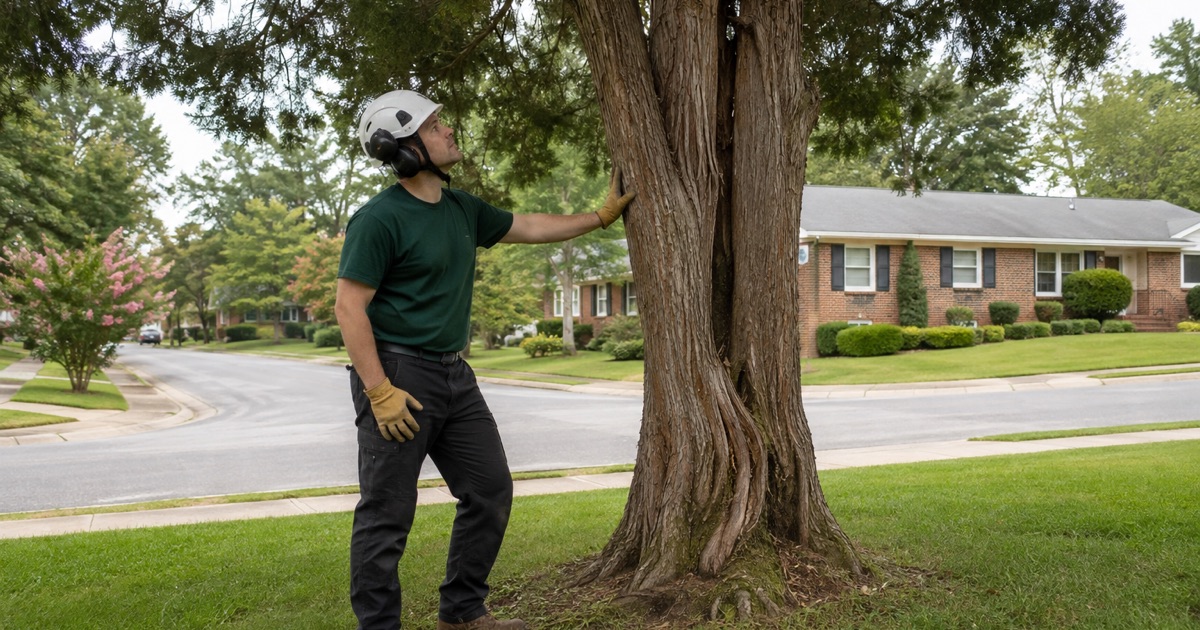
Reading the Root Flare and the Buttress Roots
Most of what kills a mature tree is below the first three feet, which is exactly where a walk-past inspection stops. We look for a trunk that enters the ground like a post rather than flaring, for girdling roots, and for a conk at the root flare — a fruiting body there means decay in the buttress roots that hold the whole tree up. Where the flare is buried under fill or mulch, root collar excavation with an air spade exposes it without cutting the roots we came to evaluate.
Crown Structure, Co-Dominant Stems and Included Bark
In the canopy the recurring defect is a union where two leaders of similar diameter meet in a tight V with bark trapped between them instead of fused wood. Included bark unions are weak in tension and they are what ice finds first, which is why the January 2026 storm produced so much split-stem work here. We record the union’s diameter, its angle and any existing crack, because those three numbers decide between cabling, reduction and removal.
Species-Specific Failure Patterns on Local Ground
Species changes the prescription. Shagbark hickory retains dead limbs long after they die; tulip poplar sheds large limbs from height with little warning; eastern redcedar was the species the National Weather Service survey of the December 9, 2023 EF-2 tornado singled out as uprooted; ash killed by emerald ash borer loses limb wood strength fast and becomes genuinely dangerous to climb. Identifying the tree correctly is not academic — it sets the timeframe on the recommendation.
Written Assessments and the People Who Read Them
Reports for a Neighbor or an HOA Board
A letter that says “an arborist looked at it” persuades nobody. A usable report names the tree, states the defect and how it was observed, identifies what sits within falling distance, and rates likelihood and consequence over a stated period. That structure — the one the Tree Risk Assessment Qualification was built around — is what lets a board vote or a neighbor’s insurer respond, rather than trading opinions across a fence.
Written Verification That a Tree Is Dead or Dying
Section 4.12 of the city zoning ordinance exempts two things a tree company meets constantly: a tree in danger of falling or damaging a structure, and written verification from a qualified specialist that a tree is dead or dying. The second is a deliverable somebody has to sign. We write it with the evidence attached — no live foliage in two seasons, bark sloughing, cambium dry at the sample point — so a reviewer is not asked to take it on faith.
Documentation an Insurance Adjuster Can Use
Carriers pay on documentation, and the useful documentation is usually created before the loss rather than after. An assessment that predates a failure establishes that the condition was known, which matters where a neighbor knew a tree was dead. After a failure, photographs of the fracture surface and the root plate tell an adjuster whether the tree was decayed or simply overloaded, and that distinction can decide a claim.
Commercial, Development and Shoreline Work
Section 4.12, the Ten-Inch Rule and the Tree Bank
On commercial and industrial zoning the city’s tree permit reaches trees of ten inches diameter at breast height or greater. From there the ladder is specific: replacement at half the removed DBH, a surveyor-stamped tree survey or a fifty-foot by fifty-foot sample, a Tree Bank contribution of $50.00 per caliper inch where on-site replacement is not made, and an agreement recorded with the Register of Deeds. Removing first means the city assumes 160 tree inches per acre.
Tree Protection Zones and Dripline Fencing
The construction-phase rules sit in section 11.4.12, and they bite hardest on the trees a site plan promised to keep. Fencing goes at the dripline, a Registered Consulting Arborist is named where root-zone disruption is proposed, and anything cut within two years of a site plan is replaced at 100 percent of its diameter rather than half. We set the tree protection zone on the ground before equipment arrives, which is when it is still cheap to move a haul road.
Old Hickory Lake Shoreline Questions
Lakefront property answers to the Corps of Engineers rather than to the city, and the Shoreline Management Plan approved November 17, 2020 is restrictive: a vegetation alteration permit is required, cutting trees greater than one inch in diameter at the base is prohibited, and Protected Shoreline — about 36 percent of the allocation — allows no cutting or underbrushing at all. We answer that question before a saw is scheduled, not after a violation notice.
After the Assessment: Treatment, Support or Removal
Soil, Compaction and the Root Zone
A declining tree on a newer lot is frequently a soil problem wearing a canopy symptom. Construction fill, repeated equipment traffic and a buried flare all restrict the fine roots that actually feed the tree, and none of that improves on its own. Air spading for root collar excavation and soil decompaction is the treatment that addresses the cause, and it is worth doing before anyone prices a fertilization program.
Support Systems: Dynamic Cabling and Static Bracing
Where the defect is geometry rather than decay, a support system can buy a valuable tree years. Dynamic cabling lets the stems move while limiting the extremes; static bracing runs through-rods to hold a split union rigid. Both need periodic re-inspection and neither is a substitute for the reduction pruning that lowers the load, so we specify them as part of a plan with a review interval rather than as a one-time fix.
When the Honest Recommendation Is Removal
Some findings end the conversation: extensive decay through the buttress roots, a crack running the length of a stem over a bedroom, or a dead ash that has already passed the point where a climber should be in it. When that is the finding we say so plainly and explain what we saw, and we will tell you when the tree can safely wait a season and when it cannot. The removal is then quoted as its own job.
Our Step-by-Step Tree Risk Assessment Process
1. Targets Before Trees
We start with what a failure would land on — a house, a driveway where cars park, a play set, a road, a neighbor’s roof — because a defective tree in the middle of a field is a different problem from the same tree over a bedroom. Mapping targets first keeps the inspection proportionate and stops a report from recommending work that protects nothing.
2. The Tree, From the Flare Upward
Each tree is identified by species and measured at diameter at breast height, then inspected from the root collar up: flare, buttress roots, trunk, unions, scaffold limbs and the outer canopy. Where something at ground level suggests decay we probe or excavate rather than guess, and where the question is in the crown we get up into it instead of judging from the driveway.
3. Likelihood, Consequence and a Timeframe
Findings are converted into a rating rather than an adjective. How likely is this part to fail, how likely is it to hit the target if it does, how bad would that be, and over what period are we saying so. A one-year horizon and a five-year horizon often produce different answers for the same tree, and a report that does not state which one it used is not saying much.
4. The Written Report and What to Do With It
You get the document, and it is yours to use — send it to the neighbor, file it with the board, hand it to the adjuster, attach it to a permit application. We include the recommended action, the priority order if there is more than one tree, and what would change our answer. Any work we then quote is priced separately, so the report stands on its own.
- 20+ Years in Middle Tennessee
- Free Written Estimates
- Emergency Storm Response