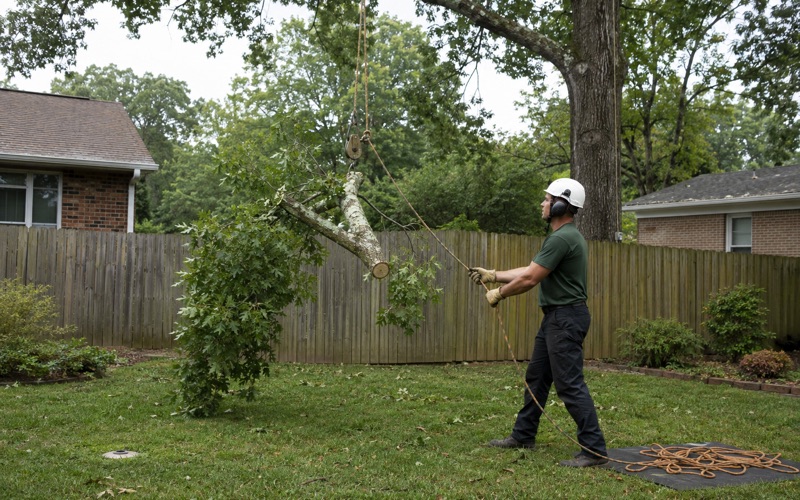
Hendersonville TN Tree Removal handles tree-removal in Brentwood the way the lots here demand it: the first question on a job is rarely how big the tree is, it is where the crane can be set. With more than 20 years of tree work across Middle Tennessee, we have learned that a mature hardwood becomes a solved problem the moment the machine has somewhere to stand.
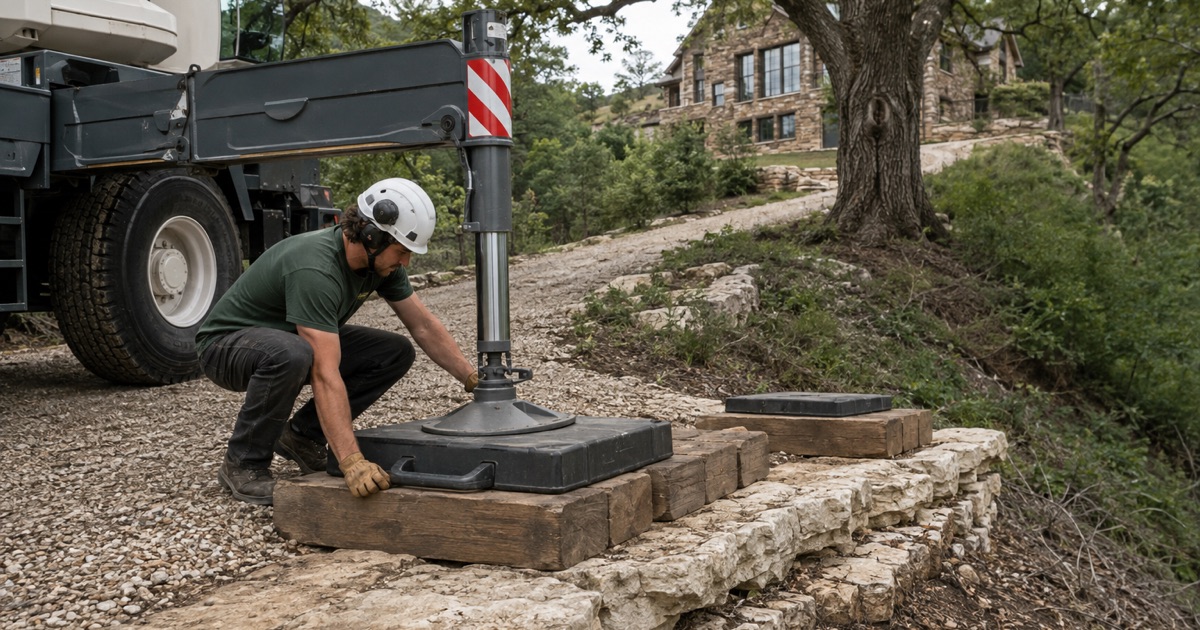
That question has two halves and both are physical. One is room, meaning the swing radius and boom angle to pick a stem cleanly instead of dismantling it from inside the canopy. The other is ground, meaning whether the dirt under four outrigger pads will carry the load without settling.
Everything downstream of those two answers is what goes into the written quote. The takedown method, the brush, the trunk rounds, the stump and the grindings, and the disposal are priced as one number rather than a takedown price with surprises attached.
What a two-acre minimum lot does to a tree job
Brentwood’s residential zoning sets a minimum lot area of two acres in the R-1 district and one acre in R-2. That one line in the code is the physical grain of the city, and it decides more about a removal here than the species or the diameter at breast height does. The tree stands on a private, wooded parcel with space around it, and that space is a large part of what we are pricing.
Room is not the same as easy. A big lot puts the drop zone, the truck and the chip pile all on ground the homeowner owns, which means every rut and every scarred lawn is theirs too. We plan the machine’s path first, run property protection mats over turf we intend to cross, and set each pick so the load lands where we chose rather than where the tree wanted to go.
The person on the phone usually owns the tree
Of 14,855 occupied housing units in the city, 13,435 are owner-occupied, or 90.4 percent, and 12,888 of those are single-family detached houses (ACS 2020-2024 5-year, tables B25003 and B25032). Renting here mostly means an apartment: only 331 renter households rent a detached house, while 790 of the 1,420 renter households live in buildings of 50 or more units.
That changes the paperwork more than it changes the saw work. One decision-maker signs, one person walks the yard with us, and the schedule follows their calendar instead of a management company’s approval chain. Where a job touches a property line or an insurance claim, we put the hazard assessment in writing so the homeowner has something to hand a neighbor or an adjuster rather than a verbal opinion.
The trees that are not the homeowner’s to authorize
Two categories sit outside that. A tree in the strip between sidewalk and curb, or on city park land, is a public tree, and removing it takes approval from the board of commissioners or its designee. On private ground the city’s tree management code withholds permission for a short list of categories unless the planning commission agrees: a tree designated rare or endangered by a state or federal agency, a tree of historical significance identified by the historic commission, a protected tree of six or more caliper inches the planning commission has deemed significant, and any tree inside a designated protection area in the HP hillside protection overlay district. Each tree removed in violation is a separate offense carrying its own penalty.
Storm damage runs through a different door. The city manager or a designee may approve removal of a public or private tree that poses a threat to public safety or that has been substantially harmed by disease, wind, ice or another act of God. Knowing which office a given call belongs to is part of the work before a climb line ever goes up.
Looking for tree-removal closer to Smyrna? See Smyrna Tree-Removal.
Crane-assisted removal against climb-and-rig, and how the call gets made
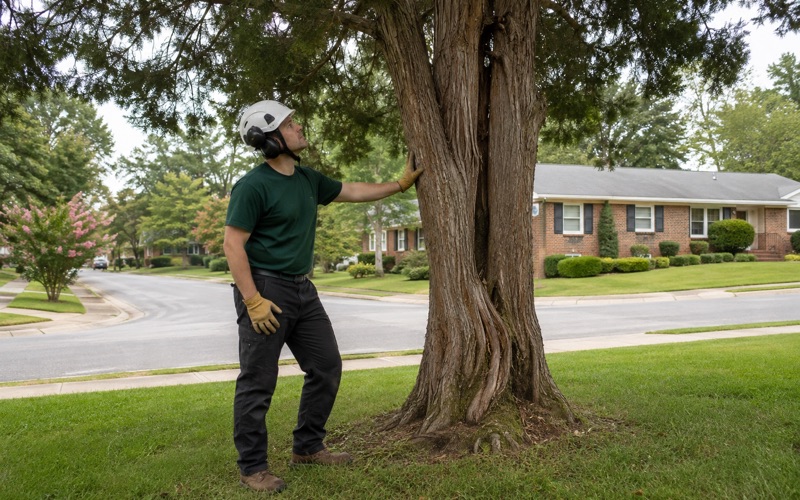
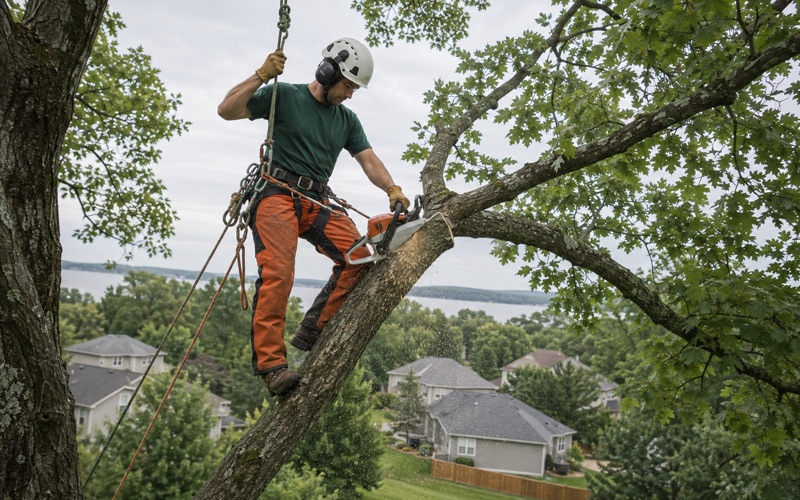
The decision is made standing under the tree, and it turns mostly on what the stem will tolerate. A climber’s rigging loads the tree itself: every piece lowered through a rigging block sends a shock load into the spar, and the working load limit of the system only means something if the wood above it is sound. Co-dominant stems with included bark, a conk at the root flare, or a flush of epicormic sprouts after an earlier failure all say the same thing, which is that the tree cannot be trusted to hold a rigged load.
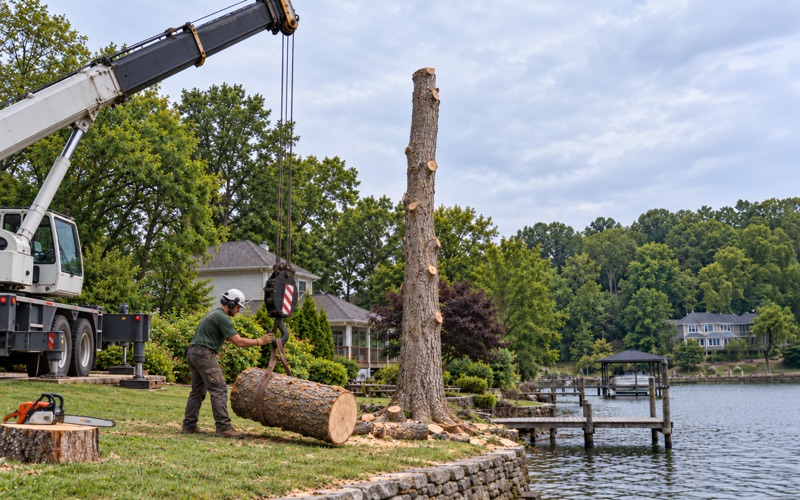
A crane takes the tree out of that equation. Picks are cut and lifted rather than dropped, green log weight is carried by the machine, and the climber’s exposure ends once the cuts are set. On a wooded acre there is usually somewhere to put a crane, which is why the machine answers so many jobs here that would be a slow and expensive climb on tighter ground.
When we still climb
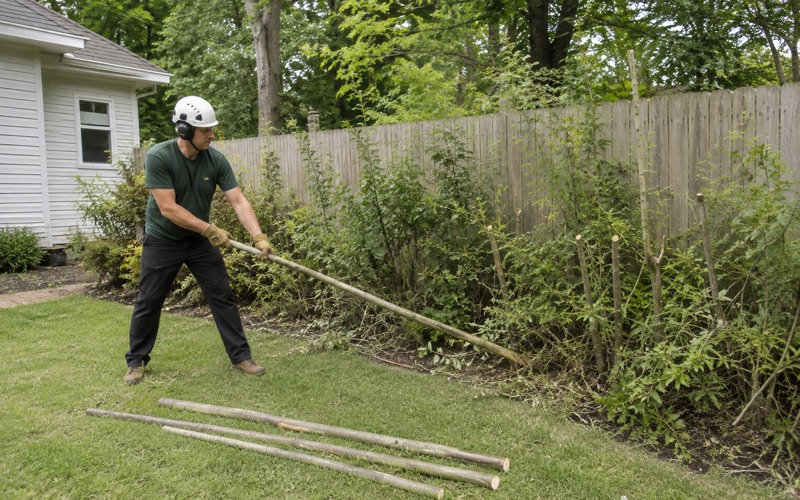
Not every tree earns a crane. A takedown in a back corner with mature turf between it and the street is often better served by a tracked spider lift and a mini skid steer, which spread their weight and leave a lawn intact. We would rather spend an extra half day on foot than repair a yard we crossed with the wrong machine.
What we put in writing before either
Tennessee issues no tree-care or arborist license. The state contractor license begins at $25,000 in materials and labor, and the Home Improvement license applies only in counties that adopted it, which Williamson County did not. ISA certification is the credential a homeowner can actually check, and the city’s own code leans on it as well, requiring an ISA-certified arborist to certify that protected trees survived construction before the three-year bond is released. We prune to ANSI A300 standards and stop for weather the way ANSI Z133 requires, and we say so before a job rather than after.
Where the crane can be set: ledge rock, and footing that changes across a few feet
Outriggers do not care what the tree weighs. They care what the ground under the pads does with the load, and in Williamson County that is a genuinely local question, because depth to competent rock varies parcel to parcel and sometimes within one setup.
The county’s own soil-mapping standard, Appendix 1 of the Subsurface Sewage Disposal Regulations, records depth to rock in inches by soil series and publishes its worked examples in exactly that form: Talbott at 20 to 22 inches to rock on 0 to 5 percent slopes, and Ashwood-Barfield-Rock Outcrops at 10 to 26 inches to rock on 15 to 25 percent slopes. Those show how the county writes a soil down. They are not a reading of anybody’s yard, and no series belongs to an address until somebody probes it.
The same regulation names five subsurface rock scenarios, which are tabular, undulating, pinnacle and trough, floaters, and stair-step or ledge rock, and it calls stair-step or ledge rock the scenario most typical of hillsides. In pinnacle and trough ground the troughs run three feet or more deep, following the joint pattern in the bedrock. On sloped ground that is exactly why footing can change across a few feet of travel: one pad lands on a ledge and the next sits over a soil-filled trough. We probe, we pad, and we set the machine for the worst of the four corners rather than the best.
Weathered rock is not the same interface
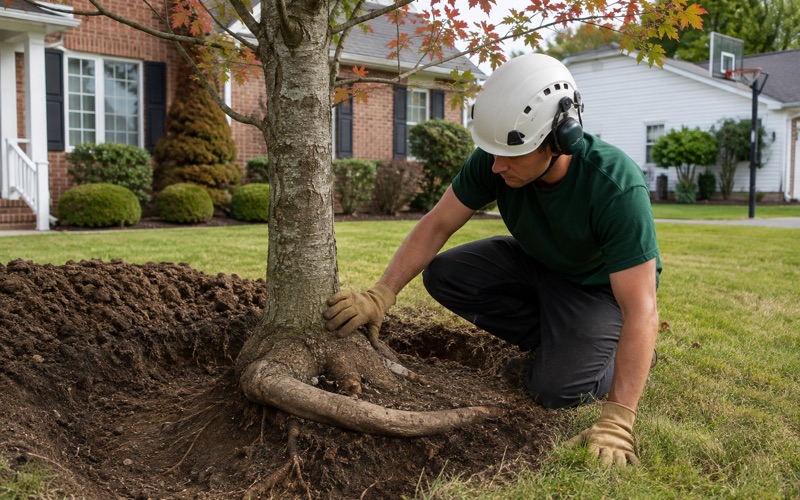
The regulation separates rock, meaning an R layer, lithic contact and unweathered bedrock, from non-rock restrictive horizons such as Cr horizons, Bt horizons, weathered rock, saprolite and fragipans. It notes that the Hermitage Formation in the Outer Central Basin is sometimes weathered deeply enough that limestone bedding planes are visible in the Cr horizon and the material looks saprolitic. A probe that stops does not always tell you which of the two it found, and one of them will take a grinder while the other will not.
Why a stump depth is a site-visit answer
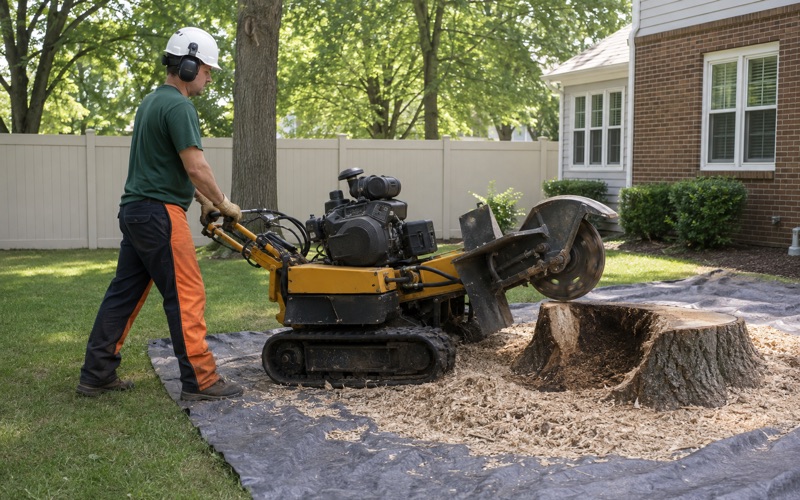
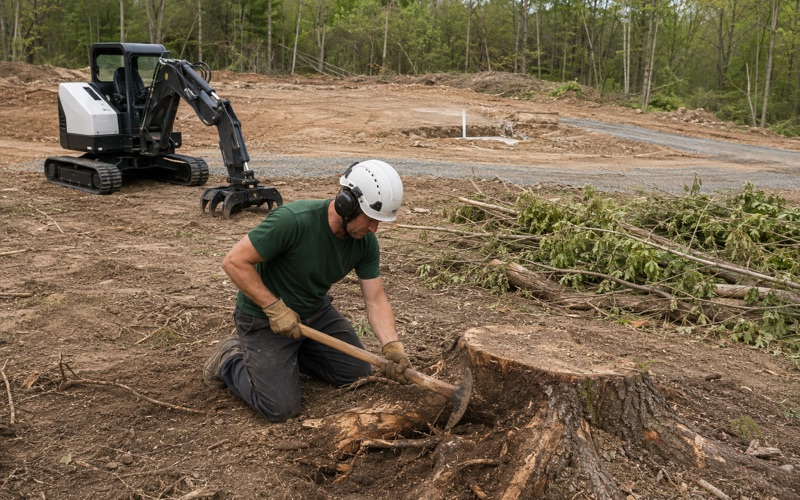
Mapped bedrock under the city is the Nashville Group, the Bigby-Cannon Limestone and Hermitage Formation of Late Ordovician age, with the Bigby-Cannon described as a brownish-gray phosphatic calcarenite 50 to 125 feet thick. A stump grinder rated to cut 12 to 16 inches below grade is at or near refusal on a soil mapped at 20 to 22 inches to rock, and shallower ground than that is ordinary in this county. So we quote grinding by diameter and by depth below grade, look at the stump before promising a number, and settle in the estimate what happens to the grindings and what the backfill will be.
Ice load, the utility, and where the wood goes
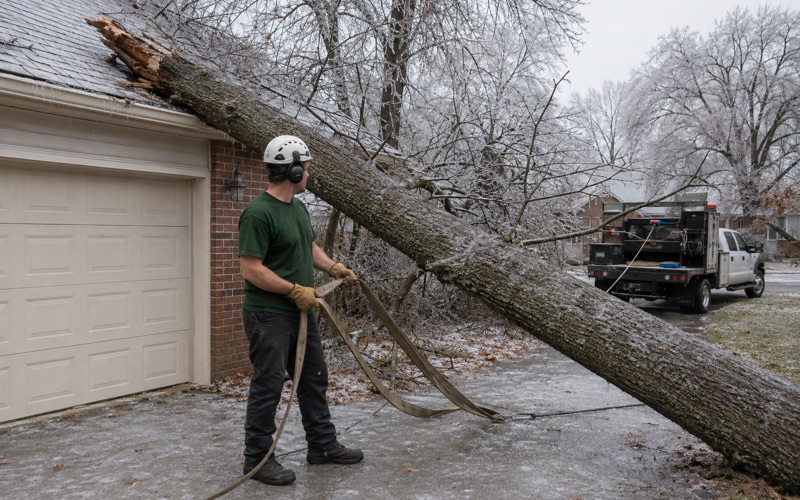
Wind gets the attention, but ice does the work that fills our schedule. Winter Storm Fern moved through beginning early Saturday, January 24, 2026, and continued into Sunday with a mixture of snow, sleet and ice. More than 300,000 outages were counted across Tennessee and close to 15,000 in Williamson County by the end of that weekend, downed trees and lines blocked county roads, and TVA dropped power to some Middle Tennessee Electric substations.
Ice loads a canopy evenly and quietly until a limb that has carried forty winters lets go. What we cut afterward is usually a long horizontal limb over a roof or a driveway, or a co-dominant union that was always going to split. We take storm calls, and where a conductor is anywhere in the picture the electric utility is called before anybody leaves the truck.
Clearance rules around the utility’s equipment
Middle Tennessee Electric serves the city and staffs its vegetation management with certified arborists. Its No Grow Zone rule keeps vegetation 12 feet clear of the front of a pad-mounted transformer and 3 feet clear of every other side, which is worth knowing before a replacement tree goes into the spot the old one came out of.
The wood, the brush and the disposal ticket
Public Works runs a monthly brush collection to every residential street using four hydraulic grapple arm trucks, and it asks residents not to pile brush directly under low-hanging limbs so the arm can lift a pile without tearing the tree overhead. That service covers what a resident cut. A contractor’s material is a contractor’s haul, and we do not stage our debris at your curb for the city to collect.
Ours goes to the Williamson County Landfill, which takes brush at $40.00 per ton, and the county’s page states that beginning May 4, 2026 there is no free disposal there and all incoming loads are charged regular tonnage fees. That makes hauling a line item rather than a courtesy, so it sits in the quote alongside the takedown, the trunk rounds, the stump and the grindings, and you see the whole number before we start.
- 20+ Years in Middle Tennessee
- Free Written Estimates
- Emergency Storm Response