
Hendersonville TN Tree Removal takes on land clearing and lot clearing in Hendersonville, TN, serving surrounding cities including Mount Juliet, Oak Hill, La Vergne, Forest Hills and Brentwood. Twenty years of working build sites, overgrown acreage and neglected fence lines in Sumner County is what lets us tell you on the first visit which permit path a job is on.
Clearing is the service where the paperwork costs more than the machines when it is handled badly. The city’s tree ordinance is triggered by zoning district, the county’s land disturbance rules are triggered by ground disturbance, the shoreline answers to the Corps of Engineers, and a construction-phase tree that was supposed to stay carries a replacement multiplier if it comes out. None of that is discoverable from the street.
So we start with the boundary and the rulebook, then price the work. That order occasionally means telling somebody their clearing plan needs an engineer’s stamp before anything can move, which is not the answer people want and is considerably cheaper than a stop-work notice with a graded lot behind it.
What Land Clearing Includes, and What It Does Not
Selective Clearing Against Clearing to Dirt
Most lots do not want to be scraped. Selective clearing keeps the specimen trees worth keeping, takes out the volunteer growth, the storm-damaged stems and anything in the building envelope, and leaves a lot that still looks like it has been there a while. Clearing to dirt is a different specification with a different price, and it is genuinely required less often than it is requested.
Forestry Mulching in Place
A mulching head reduces standing brush, saplings and small stems to chips where they stand, which eliminates haul cost, leaves the soil covered against erosion on the slopes common through this county, and finishes in a single pass. Its limits are honest ones: it does not remove large trees, it does not grub stumps, and it leaves a mulch layer rather than a clean surface a grading contractor can build on.
Grubbing, Stumps and a Usable Finish Grade
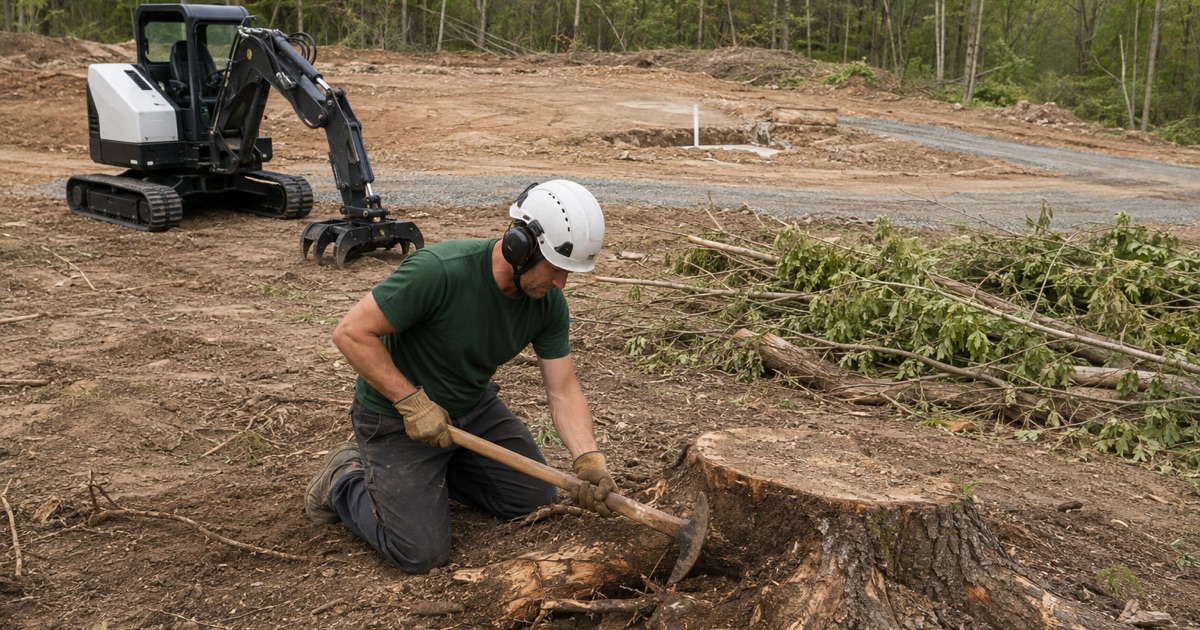
Where a pad has to be compacted, a driveway cut or a pasture reseeded, the stumps and root balls have to come out of the ground rather than be ground level with it. Grubbing produces the heaviest debris of the whole job, generates a spoil pile of soil-laden roots, and leaves holes that need backfilling and compacting. It belongs on the estimate as its own line item.
Permits Before Machines
The City Tree Permit on Commercial and Industrial Zoning
Section 4.12, adopted as Ordinance 2025-19 on October 28, 2025, applies to trees of ten inches diameter at breast height or greater in commercial or industrial districts. The ladder is specific: replacement at half the removed diameter, a surveyor-stamped tree survey or a fifty-foot by fifty-foot sample, a Tree Bank contribution of $50.00 per caliper inch where replacement is not made on site, and an agreement recorded with the Register of Deeds.
Cutting First Is the Expensive Mistake
Where trees come out of a commercial or industrial site without the permit, the city does not measure what was actually removed — it assumes 160 tree inches per acre and refuses alternative replacement. The application itself runs through the Planning Department at 101 Maple Drive North and is a development-review instrument, wanting map and parcel, zoning, proposed use, acreage and a tree survey in both PDF and DWG, reviewed with a fee.
Sumner County Land Disturbance and the Engineer’s Plans
Outside the city limits the gate is grading rather than trees. Sumner County Planning and Engineering issues no land disturbance permit until the County Engineer has approved a set of construction plans that includes grading, drainage and erosion and sediment control, stamped by a professional engineer registered in Tennessee. Clearing on a site that needs those plans is work that has to wait for them.
Tree Protection Zones on an Active Site
Section 11.4.12 governs what happens to the trees a plan promised to keep: fencing at the dripline, a Registered Consulting Arborist where root-zone disruption is proposed, and replacement at 100 percent of diameter — not half — for anything cut within two years of a site plan. Setting that fence line before the first machine arrives is the only cheap moment to do it.
Site Conditions That Move the Price
Slope, Soil and the Ground Underneath
Sumner County is split between two landforms, with the Highland Rim escarpment running diagonally across it and the Central Basin holding the ground under this city. That matters to a clearing crew because slope decides which machine can work safely, and because the deep Harpeth and Mimosa soils mapped here behave very differently under tracks in February than the shallow, rocky ground mapped in the county’s southeastern corner.
Access, Haul Routes and What a Truck Can Reach
The cost of clearing is largely the cost of moving material, so the route out is priced as carefully as the work itself. A lot that fronts a wide road with room to turn a chip truck is a different job from an interior parcel reached down a shared gravel drive with a weight-limited culvert. We drive the haul route before quoting rather than measuring it on a map.
Invasive Growth and What Is Actually in the Fence Line
An overgrown boundary is rarely uniform brush. Volunteer Callery pear, honeysuckle thickets, poison ivy vines heavy enough to conceal the wire, and occasionally a fence somebody has forgotten the location of are all normal findings. We check cut trunks for spotted lanternfly egg masses, flag anything on the neighbor’s side of the line, and tell you what condition the fence is in before you budget to fix it.
Debris: Volume, Weight and Where It Ends Up
Chipping, Mulching or Hauling
Every stem on the lot becomes one of three things: chips that stay, chips that leave, or logs on a truck. Keeping chips on site is the cheapest outcome and often the best one for erosion control, but it leaves a surface that has to be raked or removed later if the ground is going to be built on. We agree that outcome per area rather than for the whole job.
Tipping Fees Are Weighed, Not Estimated
Disposal is a scale transaction. Brush and wood go to the Sumner County Resource Authority at $45 per ton with a $10 minimum, and stumps and root balls carry the heavy construction rate on Gallatin’s schedule at $58 per ton against $27 per ton for brush. That gap is why grubbing is quoted separately, and why an estimate that folds disposal into a round number is hiding the most variable line on the job.
What the City Will Not Take
The municipal limb and brush program is for material residents cut themselves, and it states plainly that no commercial tree-cutting will be collected. Its limits rule out clearing debris in any case: no limb over 18 inches in diameter or 8 feet long, no pile larger than ten feet by ten feet, no vines and no root balls, on a rotating zone serviced roughly every three to six weeks.
Our Step-by-Step Land Clearing Process
1. Walk the Boundary With You
We walk the actual line, not the plat, and mark what stays. Property corners, the neighbor’s trees, the shoreline allocation if there is water, drainage features and the trees worth keeping all get flagged in the field, because a boundary agreed on a screen is not what a machine operator can see at 7:00 a.m.
2. Confirm the Permit Path Before Anything Moves
Zoning district, tree diameters, whether ground disturbance triggers county review, whether a site plan already governs the trees, and whether the Corps has an interest in the shoreline. That is a short list of questions with checkable answers, and getting them answered is a day of work that routinely saves months.
3. Clear in Stages, With Erosion Control In Place
Where plans require silt fence, inlet protection or a stabilized construction entrance, those go in before the clearing rather than after it. We then work in stages so exposed soil is limited at any one time, which is both what an approved plan usually requires and what keeps a slope where it belongs during a wet Middle Tennessee spring.
4. Grub, Grade and Hand Over a Usable Site
Stumps come out where the specification calls for it, holes are backfilled and compacted, and the surface is left at whatever finish was agreed — mulched, rough-graded or ready for a grading contractor. You get a written account of what was removed and what was left standing, which is the document you want if anyone later asks what happened to a tree.
- 20+ Years in Middle Tennessee
- Free Written Estimates
- Emergency Storm Response