Hendersonville TN Tree Removal has been working in Middle Tennessee for more than twenty years, and tree removal in Mount Juliet is a particular kind of job: the tree we are called to is usually the same age as the house standing next to it. Builders set these trees out with the sod and the mailbox, and two decades on they are pressing against a roof edge, a driveway slab or a fence line.
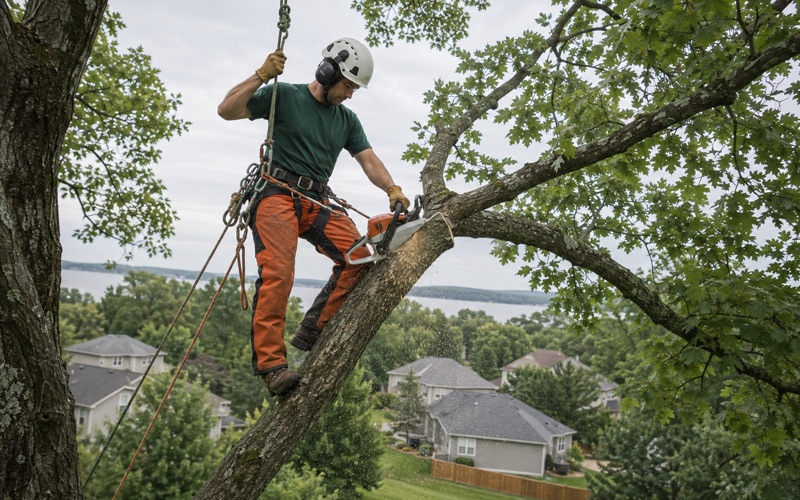
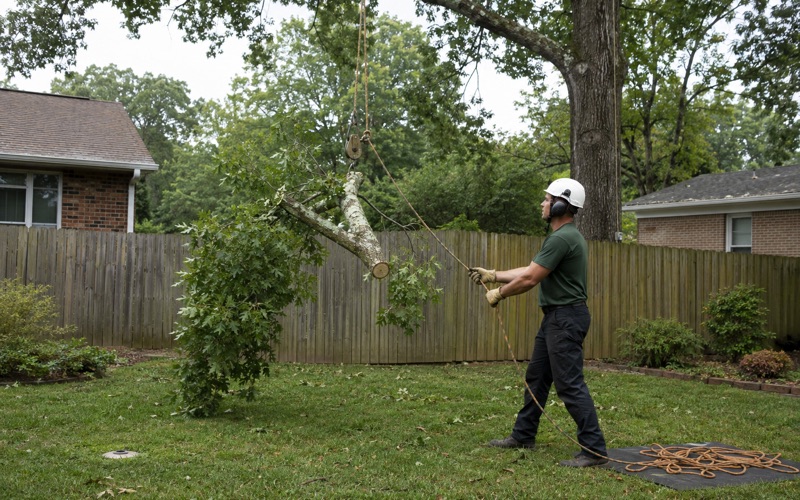
That timing changes what the work actually is. A tree at this stage is large enough to do real damage and heavy enough to demand proper rigging, but it is rarely at the size where a crane is the obvious first answer. We own that capacity and bring it when the target underneath justifies it, not as a matter of course; most removals here are climbed, rigged and lowered in pieces over turf the homeowner would like to keep.
So access gets measured before anything is priced. Gate width, the carry distance from the drop zone to the truck, and whether a chipper can reach the tree at all decide the method, and the written quote covers the takedown, the brush, the trunk rounds, the stump and the grindings together.
What twenty years of growth looks like on a Mount Juliet lot
The housing data explains why so many yards arrive at this point at once. Of the city’s 16,952 housing units, 6,735 of them, or 39.7 percent, were built in 2010 or later, only 1,503, or 8.9 percent, predate 1980, and the median unit falls in the 2000-2009 band (ACS 2024 five-year estimates, table B25034). A place that held 2,879 residents in 1980 put up nearly all of its housing, and planted nearly all of its yard trees, inside one generation.
The residential pattern underneath that is just as uniform. There are 12,485 one-unit detached houses in the city and 10,517 of them are owner-occupied (ACS 2024 five-year, tables B25024 and B25032), which amounts to a single planting cohort on a single kind of lot. It is why neighbors on one street tend to call in the same season about the same species doing the same thing.
It also means the work is seasonal in a way it is not everywhere. One hard ice event or one wind line moves a whole street from wanting an estimate to needing a crew in the same week, and the trees that fail are usually the ones that were already crowding a structure. Booking the removal you can see coming, in a quiet month, is the cheaper half of that pattern.
The trees the builder planted too close to the house
Landscape plans are drawn to look finished on the day the house sells rather than in year twenty. A maple set eight feet off a foundation corner, a pair of hardwoods flanking a driveway apron, a screen run tight along a property line: all of it is reasonable at planting caliper, and all of it is a problem once those trunks reach a diameter at breast height worth measuring.
By that point the options have narrowed. Crown reduction and crown raising buy clearance where the structure of the tree allows it, but a stem carrying co-dominant leaders with included bark at the union does not become sound by being shortened, and a root plate already under a slab will not be pruned into a better location. We tell you which of those we are looking at before we put a number on it.
Looking for tree-removal closer to Oak Hill? See Tree-Removal Services in Oak Hill.
Roofline, driveway and fence-line clearance
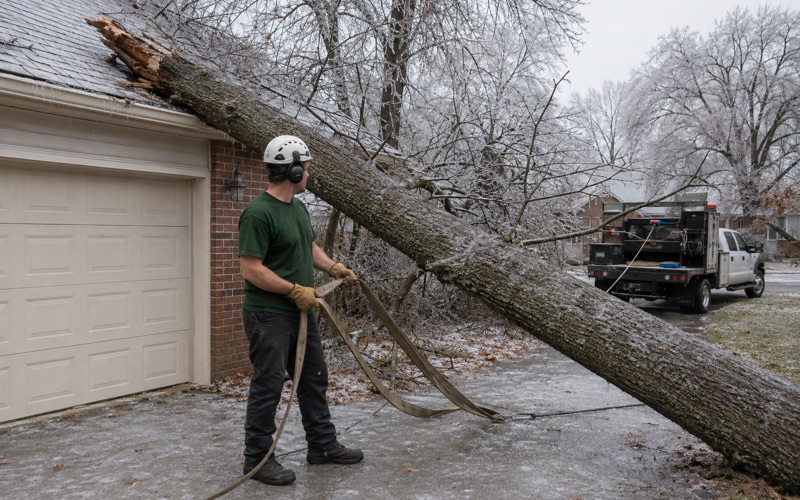
Clearance work here is mostly about three surfaces. Limbs lying on shingles hold moisture and abrade the roof in wind, and they are the first thing to load up in an ice event; the January 25-26, 2026 storm laid down half an inch or more of ice, and ice fails limbs by weight, which means the failure lands on whatever sits directly below.
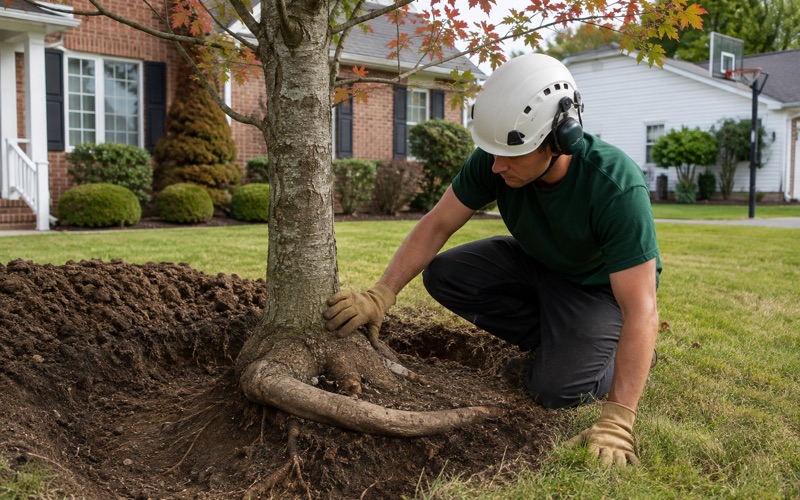
Driveways and walks are the second. Roots run shallow and lateral under a slab and lift it, and before we treat that as a removal we would rather see the root flare, which on a builder-planted tree is often buried several inches deep in fill. A root collar excavation with an air spade answers that question without guessing, and sometimes the answer is soil decompaction and a different pruning plan instead of a takedown.
The third is the fence line, where a tree belongs to one deed and leans over another. We put hazard assessments in writing precisely so a homeowner has something to hand a neighbor, an HOA board or an insurance adjuster rather than an argument about opinions.
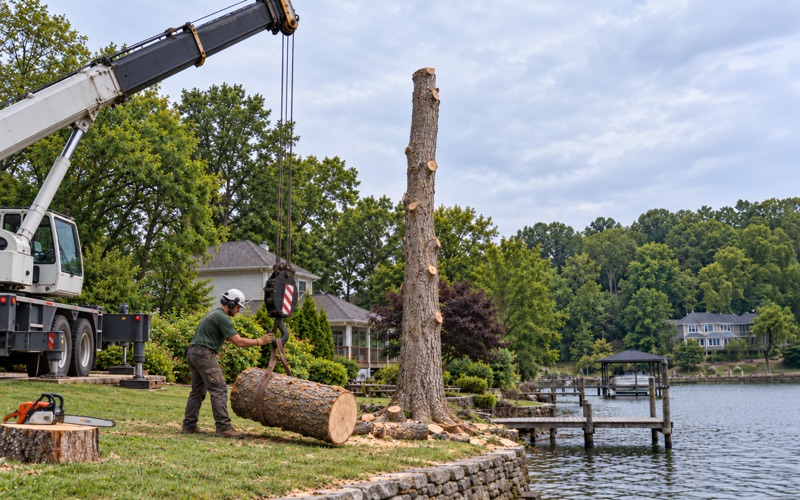
Small yards also set the rigging plan. Green log weight is what actually decides whether a piece comes off in one cut or three, so the lowering device, the rigging block and the working load limit on the line get chosen for the wood rather than for the schedule. On a lot where the drop zone is a strip of lawn between a patio and a fence, that arithmetic is the job.
When the electric line is in the picture
Middle Tennessee Electric maintains a 20-foot right-of-way clearance along its lines and keeps a five-foot radius around service lines on its regular pruning cycle, and its contractors clear to ANSI Z133.1. Members may prune outside the right of way as long as the debris cannot contact electrical equipment, which is a narrower permission than most people assume it to be.
Two of the utility’s published positions save arguments later. MTE does not top trees, so nobody should expect rounding over or shaping as the fix for a line conflict, and it does not place dirt, seed or straw on a site after grinding a stump. When a line is anywhere in the work zone we call the utility first and price our part around what they will and will not do.
Leyland cypress: sold as a screen, removed as a tree
Leyland cypress is the plant we are asked to take out here most often, and the reason is spacing. UT Extension does not recommend it and calls for planting no closer than twelve feet, while homeowners commonly set it on eight-foot centers to close a gap fast. It matures at sixty to seventy feet with a spread over twenty feet, so the row that screened a back yard in year three is a line of interlocked forest trees in year twenty.
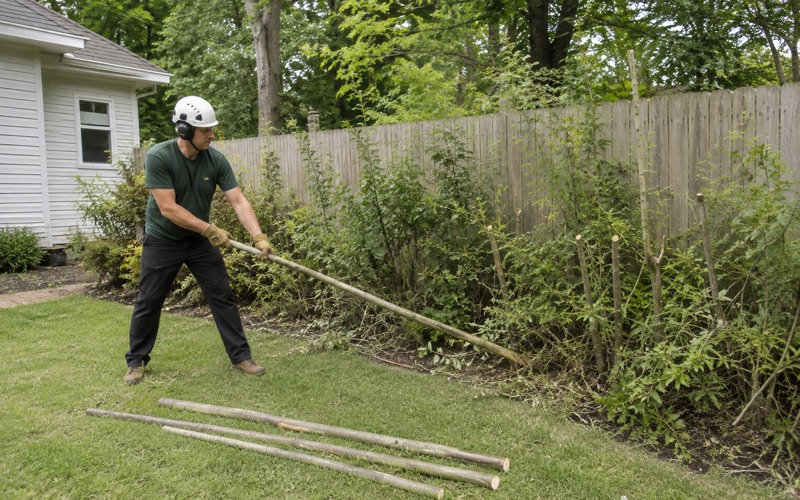
Crowded like that, the lower limbs shade out and die, the crowns fuse, and the interior goes brown and stays brown, because this species does not push new growth from old bare wood. There is no pruning fix for that geometry, so the honest job is removal of some or all of the row, usually down a side yard with a tracked spider lift or on climbing line, with property protection mats over anything we cross.
When a twenty-year-old tree is still a hazard
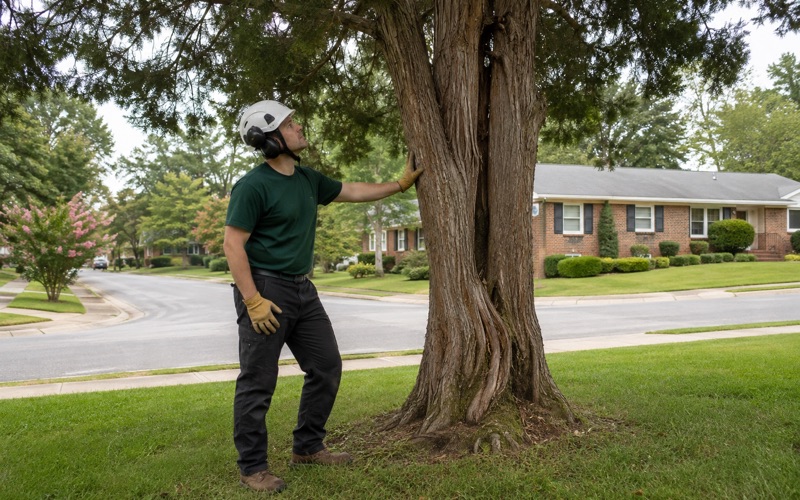
Age is not the only thing that puts a tree on the list. A conk at the root flare, a flush of epicormic sprouts along a stripped limb, or a seam of included bark in a union are structural findings we look for on every estimate, and any one of them can outrank a much older tree in the queue.
Some trees here have also been carrying damage since the March 3, 2020 tornado, which killed three people in Wilson County and left extensive tree damage in its path. A crown that lost half its structure that night and has been growing weak replacement wood ever since is a legitimate removal, and we say so plainly rather than dressing it up. We also stand down for weather the way ANSI Z133 requires, which is the difference between an emergency response and a promise to climb in an ice storm.
Clearing, grinding, and what does not go back in
On lots still under construction the constraint is not the tree coming down but the one staying up. The city’s zoning ordinance preserves existing trees of at least 1.75 inches caliper with a protected ground area equal to the greater of a seven-foot radius or one foot of diameter for every inch of the tree’s circumference, marked clearly in the field while work is underway.
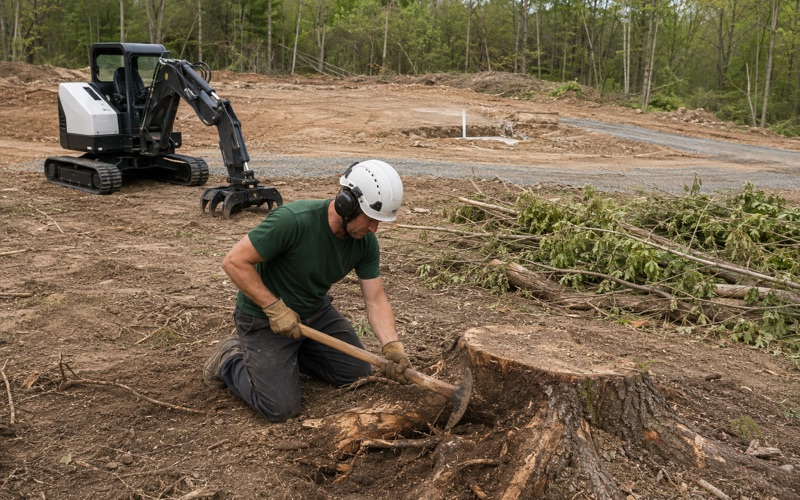
That protected area is a real working limit rather than a formality. We set the dripline fencing before equipment arrives, plan the drop zones and travel lanes outside it, and take out what has to come out with a mini skid steer instead of driving a loaded machine across a root zone somebody is required to keep intact.
Commercial sites carry their own version of the same rule. The ordinance asks for one natural canopy tree for every 2,000 square feet of total vehicular surface area, and it requires unhealthy or dead plant material to be replaced within one year of notification or by the next planting period. A parking-lot tree that has failed is therefore a removal with a replanting date attached, and we quote it that way.
Stump grinding in a subdivision lawn
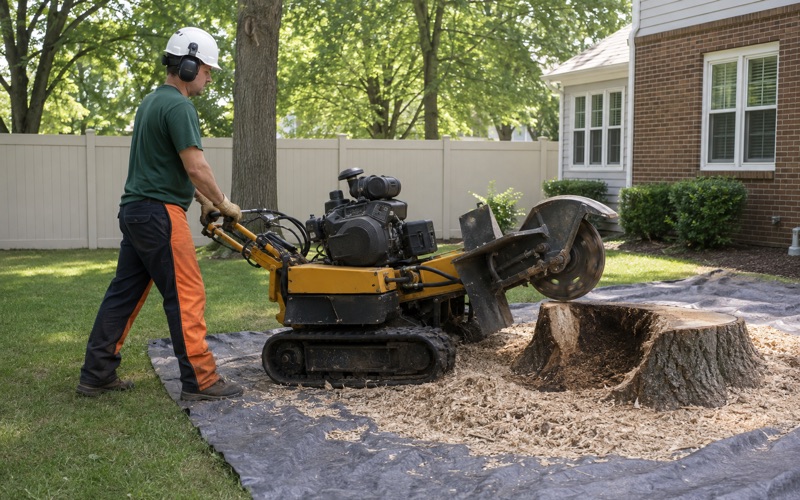
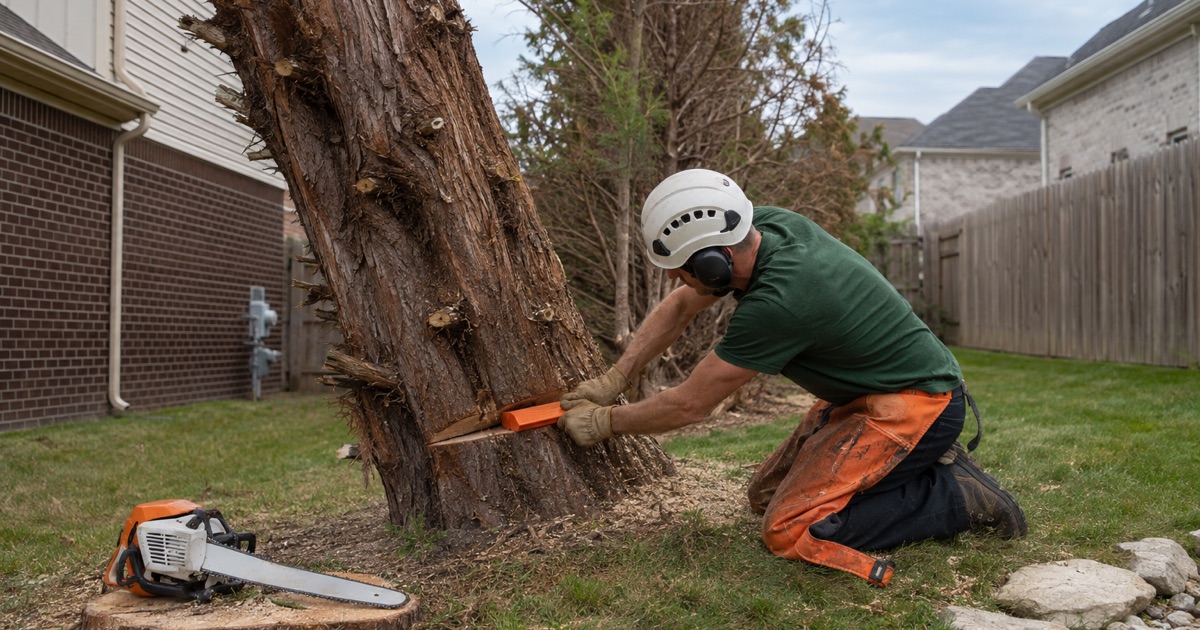
Stumps get quoted by diameter and by depth below grade, and both halves belong in the estimate. In a fenced back yard the machine that fits through the gate is a narrow-access grinder, which works more slowly and prices differently than the one we would run on an open front lot, and that is a conversation to have before the truck is booked.
The part homeowners are most often surprised by is the volume of grindings a stump produces and the question of what happens to the hole. On a utility-adjacent stump in particular, no dirt, seed or straw arrives afterward from the electric side. We settle in writing whether the grindings stay as backfill, get raked out and hauled, or are replaced with topsoil, so nobody discovers the answer by walking outside.
Who is accountable for the work
Tennessee issues no trade-specific tree-care or arborist license, and Wilson County is not among the nine counties that adopted the state’s Home Improvement license, so a residential job in the $3,000 to $24,999 band carries no county license requirement here. Credentialing above that rests on the $25,000 state contractor threshold, on insurance, and on voluntary qualifications.
That puts the weight on the paperwork you are handed. We prune to ANSI A300 standards, our assessments are written by people holding the ISA Certified Arborist credential and the Tree Risk Assessment Qualification, and the scope you sign is the scope we work to.
- 20+ Years in Middle Tennessee
- Free Written Estimates
- Emergency Storm Response