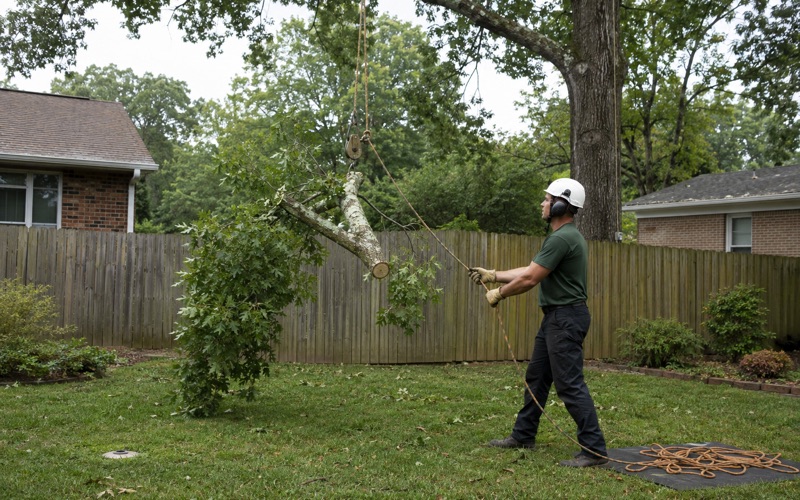
Hendersonville TN Tree Removal has spent more than twenty years on tree-removal in Nolensville and the rest of Middle Tennessee, and the work in this town starts from an unusual premise. Nearly everything we are called to take down here was planted deliberately, by a builder or a homeowner, inside the last twenty-five years.
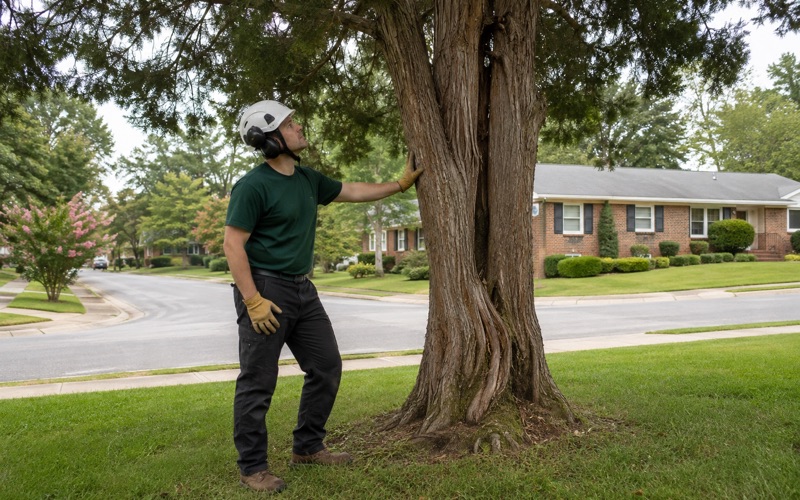
That changes what a crew is looking at when it walks a yard. A tree failing at twenty years old is almost never failing from age or advanced decay; it is failing along a defect that was set into it in the nursery row or in its first few seasons in the ground. Telling those apart is the difference between a removal that had to happen and a removal a few hundred dollars of structural work would have made unnecessary.
We quote the whole job in writing before a saw comes off the truck, covering the takedown, the brush, the trunk rounds, the stump and the grindings. Access gets measured before anything is priced, because gate width, carry distance to the truck, and whether a chipper can reach the tree at all decide most of what a job costs.
What a Twenty-Year-Old Canopy Actually Does
The housing stock here is young in a way that can be measured rather than guessed at. Only 1.1 percent of Nolensville’s housing units predate 1960 and just 6.6 percent predate 1980, with the median unit landing in the 2010-2019 build band (ACS 2020-2024 five-year estimates, tables B25034, B25024, B25003 and B25032).
The same source puts 97.2 percent of the stock in single-family detached houses and 93.6 percent of occupied units in owner-occupied hands, 4,097 owner-occupied detached units in all. This is a town of private yards, and a yard tree in a town like this one is nearly always a specimen somebody selected, sited and watered.
So the defects we price for are the ones planted stock carries, not the hollow trunks, conks at the root flare and lifted root plates that turn up under much older canopy. Two of them account for most of the calls.
Co-dominant stems and included bark
A young shade tree that was never pruned for structure often carries two stems of roughly equal diameter rising from the same point instead of one dominant leader. Where those stems press together, bark gets trapped in the union instead of wood, and the joint has no real fiber holding it.
That is included bark, and it is what splits a healthy-looking maple down the middle in a single loading event. It is also visible from the ground years ahead of time, which is the only reason it is worth talking about at all.
Caught early enough, the fix is not a removal at all. Reducing the weaker of the two stems over a season or two lets the stronger one take over, and a tree corrected at eight inches at diameter at breast height never becomes the problem it would have been at eighteen.
Girdling roots and a buried root collar
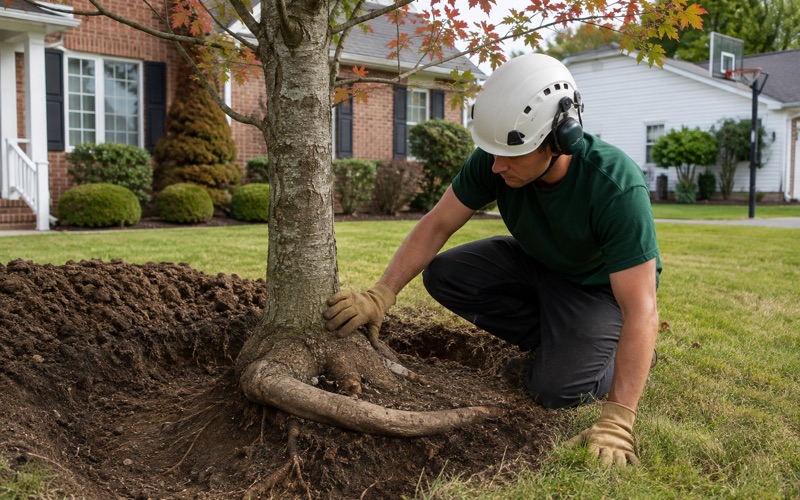
The second defect sits below grade. A tree planted too deep, or left with circling roots from its container, ends up with roots wrapping the trunk and slowly strangling it while the root flare stays buried under mulch and soil where nobody looks.
The tell is a trunk that enters the ground like a utility pole with no visible flare, usually with thin crown density and epicormic sprouts low on the stem. Root collar excavation with an air spade, plus soil decompaction across the critical root zone, is sometimes enough to buy that tree years.
Looking for tree-removal closer to Mount Juliet? See Tree-Removal in Mount Juliet.
The Species the Town Names, and the Wires Above Them
Nolensville has published its own opinion about which trees it expects to disappoint. Appendix B, section 1.4.5 of the Zoning Ordinance deems undesirable any species known to be weak, short-lived, disease-prone, or to belong to an overpopulation of its species, and names Boxelder (female), Silver Maple, Hackberry, American Elm, Osage Orange (female), Cottonwood except hybrids, and Bradford Pear.
That is a planting-credit rule governing replacement stock, expressly not a ban, and nothing in it obliges anyone to remove a tree already standing in a yard. What it gives a homeowner is the town’s own written expectation that several of the fastest-growing trees in these subdivisions were never going to be long-term structure.
The trees that do hold up in this part of the Outer Nashville Basin are the ones the ecoregion already grows over its phosphate-rich limestone residuum: white oak, northern red oak, tuliptree, sugar maple, hickory, eastern redcedar, black locust and honeylocust. That matters on a removal quote, because what goes back into the hole decides whether we are standing in the same yard again in fifteen years.
Street trees at fifty feet, and the trees the town asks you to keep
Section 1.3.2 of the same appendix sets street trees on residential subdivision sites at an average of 50 feet apart, with a minimum of 35 feet and a maximum of 65, planted no closer than five feet from the back edge of the sidewalk.
The same section states that all trees of 24 inches or greater are to be preserved if possible. On a tree that has actually reached that size, we would rather quote crown cleaning and a reduction than a takedown, and we put that recommendation in writing.
Six feet of clearance under the MTEMC easement
The town’s landscaping appendix records the utility corridor as well. Section 1.4.6(B) notes that MTEMC maintains a 40-foot right of way extending 20 feet on both sides of existing lines, requires a minimum clearance of six feet, and makes it unlawful to plant a species that will outgrow the lowest line inside a recorded overhead easement.
Middle Tennessee Electric clears that corridor itself, cutting back and eventually removing what grows into it. Whenever a line is involved in a storm call, we contact the utility before we rig anything, and we will say plainly when the tree in question is theirs to handle rather than ours.
Ice Loading Is the Failure Mode That Matters Here
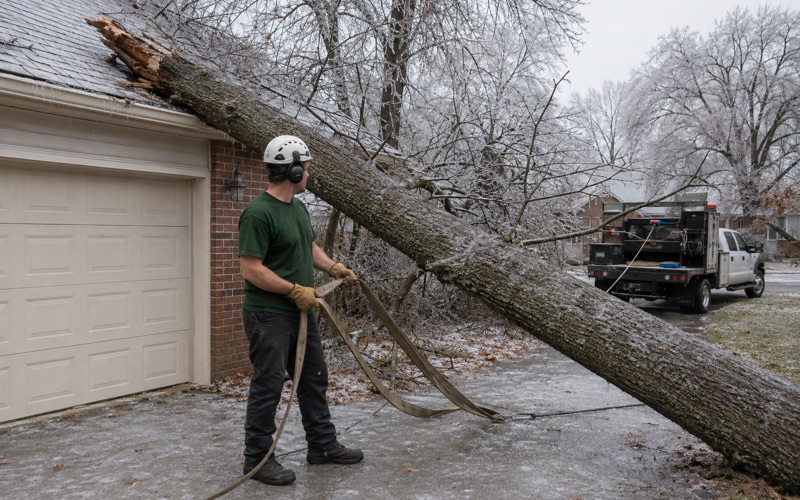
The winter storm of January 24-25, 2026 laid a quarter to a half inch of ice and more across Middle Tennessee and was reported as the worst the region had seen in decades. Ice loading works hardest on wide, horizontal, poorly attached limbs, which is precisely the architecture a fast-grown and lightly pruned subdivision tree carries.
Wind is a genuine hazard here too, with Middle Tennessee averaging 18 tornadoes a year across the 1995-2025 record. But the load that found the defects in this particular canopy was weight sitting on long lateral limbs, not a gust.
Cabling, bracing and structural pruning
When a tree is structurally defective but otherwise healthy, the product is a support system rather than a stump. Dynamic cabling shares load between competing stems while still letting them move, static bracing rods a union that has already begun to separate, and either one is sold as a maintained installation rather than a permanent fix.
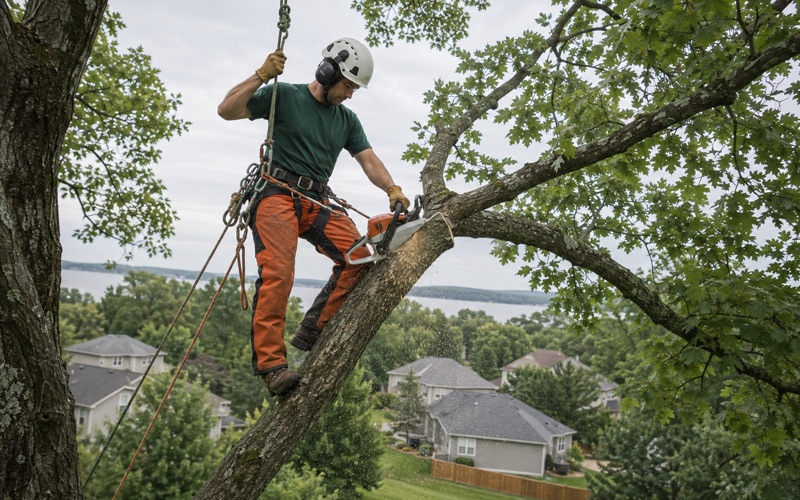
Pruning does the rest of the work. We prune to ANSI A300 standards, choosing crown cleaning, raising, reduction or thinning for the defect actually in front of us, and we stop for weather the way ANSI Z133 requires instead of promising to climb through an ice event.
When removal is the honest answer
Some trees are past all of that. A union already split, decay at the root flare, or a stem leaning over the one thing on the lot that cannot be replaced generally means the money is better spent on the takedown and a replanting.
Every one of those judgments is a risk assessment rather than an opinion about the tree. We work the way a Tree Risk Assessment Qualification asks us to, naming the target, naming the part likely to fail, and saying how likely the two are to meet, then pricing against that answer instead of against how bad the tree looks.
When that is the call, it goes on paper. A written hazard assessment is something a homeowner can hand to a neighbor, an HOA board or an insurance adjuster, and we give a plain answer about what a homeowners policy typically will and will not pay for before a claim is ever filed.
Stumps, Grindings, and Where the Lot Sits
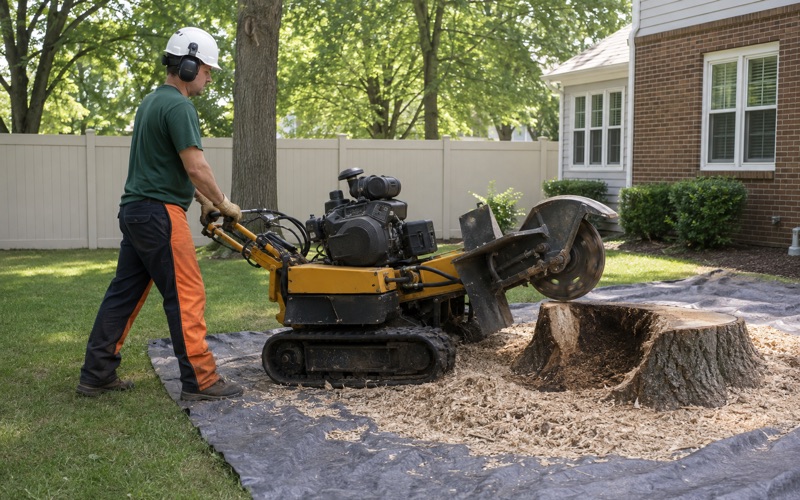
Grinding is where the ground itself changes the job. On the flats along Mill Creek the working soils are the deep terrace and valley series typified by Armour, well drained, formed in old alluvium and valley fill over limestone residuum, with bedrock more than five feet down. A grinder rated 12 to 16 inches below grade is cutting soil the whole way there.
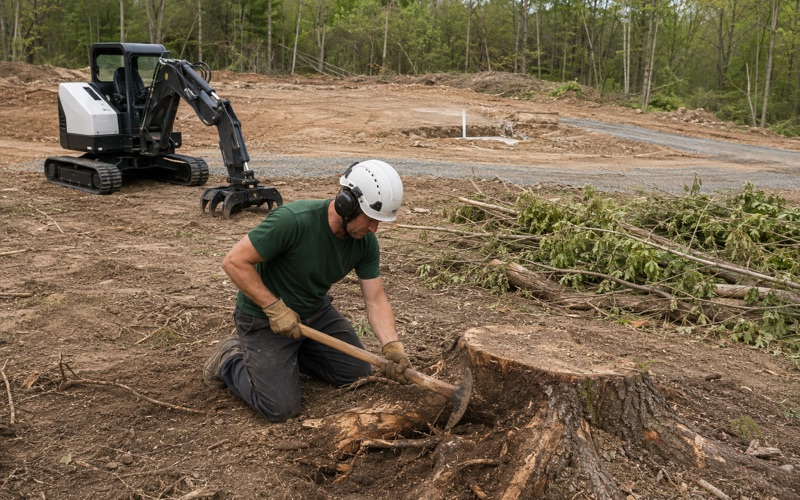
The limestone uplands reverse that. Talbott, formed in clayey residuum weathered from limestone, runs only 20 to 40 inches to bedrock, and Bodine, the most extensive series mapped in Williamson County, carries 35 to 80 percent chert rock fragments through its control section. Chert in that volume is what dulls a grinder wheel; depth to rock is what stops it outright.
Those series are typical of those landforms rather than a survey of any one address, so we read the hole rather than a map. Stumps are quoted by diameter and by depth below grade with the grindings and the backfill settled in the estimate, and a narrow-access grinder and property protection mats come along when the turf matters.
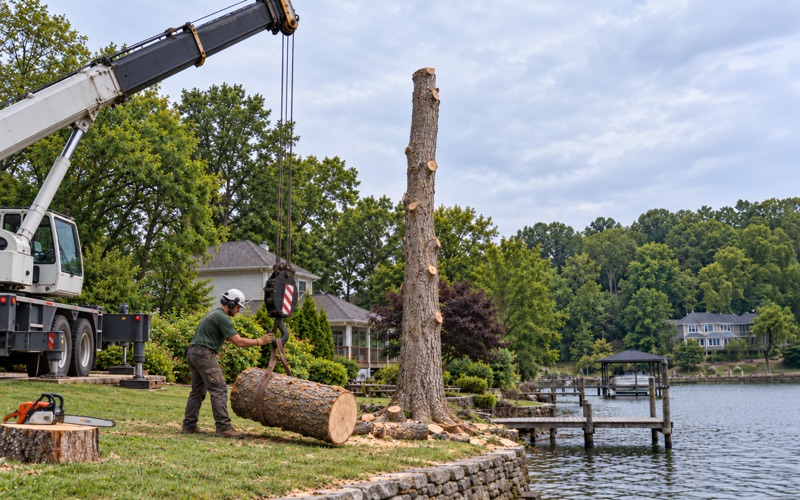
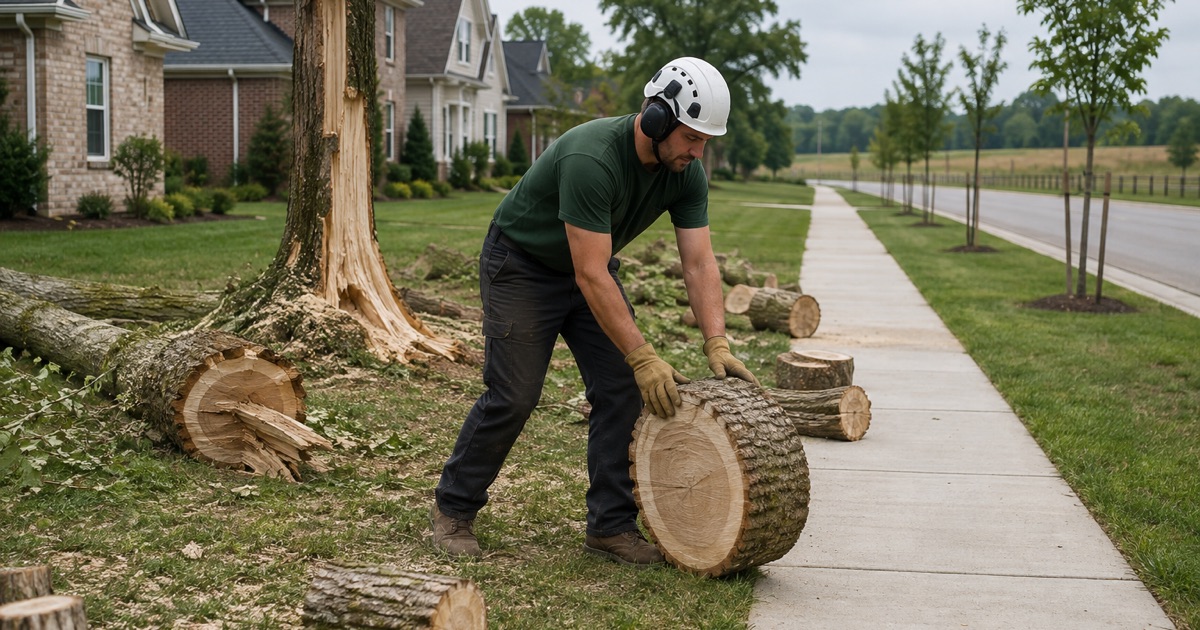
Wood leaves the lot the same way it was priced. A whole-tree chipper takes the brush, trunk rounds are cut to a length two people can actually move, and green log weight is why we settle before the job whether the rounds stay stacked on site or ride out on the truck.
Brush, wood and the county gate
The town operates no landfill of its own, so brush and clean wood from a residential job go to the Williamson County Landfill or the county convenience centers, and brush delivered to a convenience center has to be three feet in length or less. Free disposal at the landfill is suspended from May 4, 2026 until January 2, 2027, with all incoming loads charged regular tonnage fees, which makes hauling a real line on the estimate rather than a rounding error.
Who the town’s tree rules actually bind
One clarification saves a great deal of confusion. Nolensville’s tree provisions attach to construction, site plans, subdivisions and grading permits, so a crew working ahead of a builder is inside that ordinance, while nothing we have found asks a homeowner on a finished lot to obtain a town permit before taking a tree out of a back yard.
On a development job the tree survey we work from is a landscape plan somebody else stamped, and we work to it. On a yard tree the decision is yours, and the constraints are the ones standing on the ground: access, targets, and what the tree is actually doing.
- 20+ Years in Middle Tennessee
- Free Written Estimates
- Emergency Storm Response