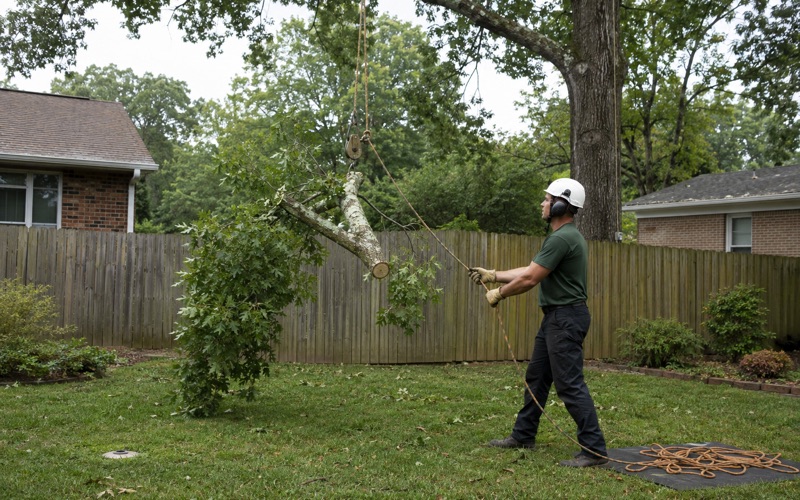
Hendersonville TN Tree Removal has worked in Oak Hill for more than twenty years, and tree removal in Oak Hill is a job we price from the ground up rather than from the canopy down. The tree is the visible half of it. What sits under the tree — how far the soil runs before it meets rock, how much loose stone is mixed through it, how steep the grade is beneath the machine — decides how the tree comes apart, how deep a grinder gets, and what the work honestly costs.
That is not a general observation about Middle Tennessee. Inside this one small city the material under the machine changes from one job to the next, sometimes between a morning appointment and an afternoon one, and nothing at the surface announces the switch. A crew that has only ever worked one of the two grounds here will quote the other one wrong.
So we measure first and price second. Access gets looked at before anything else — gate width, the carry distance back to the truck, whether a chipper can reach the tree at all — and then the takedown, the brush, the trunk rounds, the stump and the grindings go into a single written quote. Twenty years on Central Basin limestone and Highland Rim slopes is mostly twenty years of learning which of those numbers moves, and why.
Six hundred feet of vertical range inside eight square miles
The city marker stands at 581 feet across 7.845 square miles of land, and the high ground here is nothing like that number. The majority of Radnor Lake State Natural Area lies inside the corporate limits, and it is an outlier of the Western Highland Rim carrying some of the highest ridges in the Central Basin, over 1,200 feet. Call it six hundred feet of vertical range inside eight square miles.
We do not read that as scenery. We read it as a soil boundary with a grade attached: the low ground is Central Basin floor and behaves like it, while the high ground is Highland Rim and behaves like something else entirely. Between the two, the material under the machine changes, and with it the anchorage a tree has, the depth a grinder can reach, and the way a tree fails when it fails.
A morning job and an afternoon job are not the same job
We can spend a morning on a flat frontage where the truck parks a few steps from the trunk and the chipper works off the driveway, then spend the afternoon on a slope where the same species at the same diameter has to come down in rigged pieces because there is nothing below it to drop into. Same city, same crew, the same tree on paper — a different job and a different price.
That is why our estimates are done standing on the lot instead of off an aerial photograph. An aerial shows the crown. It does not show the grade under the drip line, the loose stone turned up in a garden bed, or the gate at the side of the house that a machine will not fit through.
Looking for tree-removal closer to La Vergne? See La Vergne Tree-Removal.
Chert or clay: what is actually under the stump
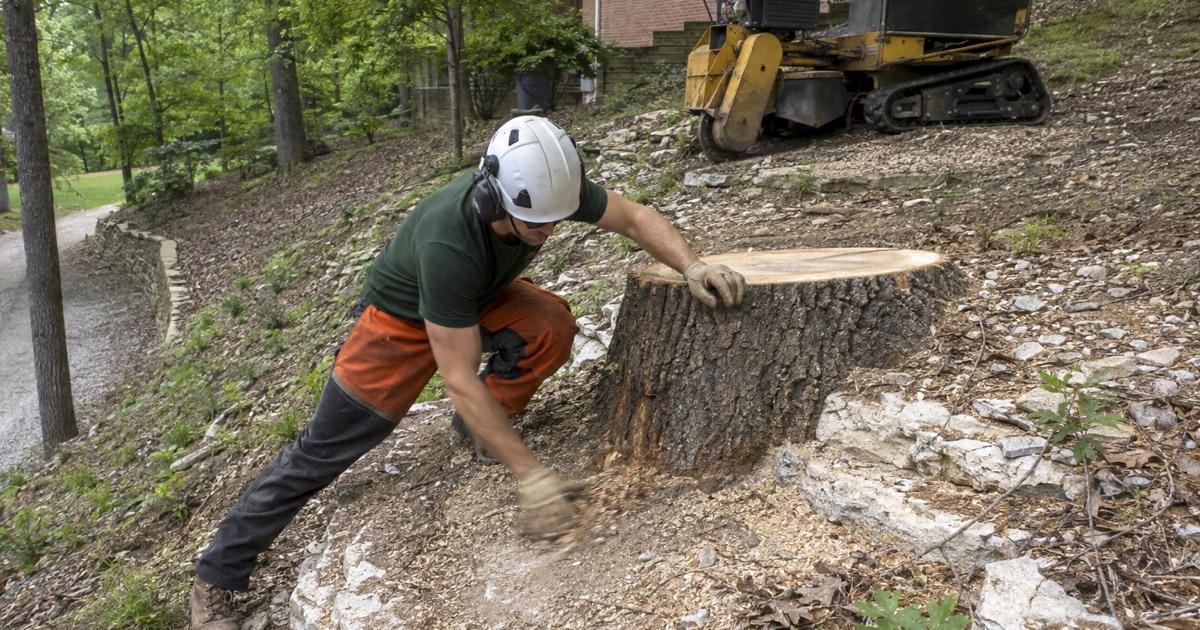
On the steep ground the mapped material is Bodine, the most extensive soil series in Davidson County by acreage and mapped there at 20 to 50 percent slopes. It is somewhat excessively drained, formed in colluvium or residuum weathered from cherty limestone, and it runs more than five feet to bedrock — but it carries 35 to 80 percent chert rock fragments through the particle-size control section. Depth to rock is not the constraint on Bodine. The volume of loose stone is, both for what a root plate can hold onto and for what a grinder wheel has to work through.
On the basin slopes below, the material is clayey limestone residuum, and the numbers invert. Mimosa, formed in residuum weathered from phosphatic limestone, runs 40 to 60 inches of solum and depth to rock. Talbott, also mapped in the county, is the shallow case at 20 to 40 inches over limestone. Neither carries Bodine’s stone load, and both drain slowly.
Why we will not quote a grind depth over the phone
A stump grinder rated 12 to 16 inches below grade is comfortably inside soil on one of those materials and can be into weathered limestone on another. Nothing at the surface tells a homeowner which one is under their lawn, and shallow rock is documented here at scale: about 81 percent of Davidson County soils are rated very limited for septic absorption fields, shallow bedrock among the reasons.
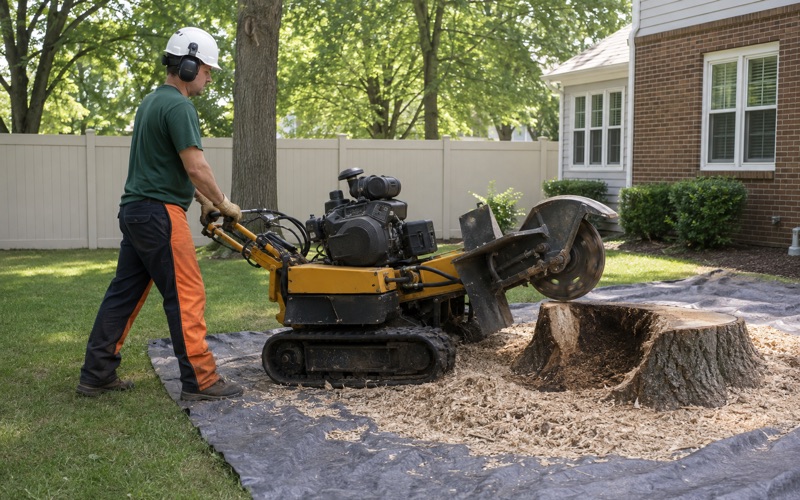
So we quote stump grinding by diameter and by depth below grade, and the grindings and the backfill are settled in the estimate rather than argued about afterward. On the chert we plan for wheel wear and a slower pass. On the shallow clayey ground we plan for the wheel to find rock before it finds the depth a homeowner had in mind, and we say so in writing first rather than discovering it with the machine running.
These are landform readings, not a survey of your yard
The series above are county-scale and landform-scale facts, not a soil query of anyone’s parcel. We use them the way a crew should: to know which two possibilities we are choosing between before we arrive, and then to probe once we are on the ground. Where a stump sits behind a fence line, a narrow-access stump grinder is often the difference between grinding it out and excavating it out.
How a tree fails on this ground
The failure we are usually called to on the slopes is not a snapped trunk. It is a wide, shallow root plate spread over weathered rock and loose chert, saturated after a long rain, sitting on a grade under a mature crown. The clayey residuum lower down works against a tree in its own way: it drains slowly, so water sits in the root zone instead of moving out of it.
Ice, not wind
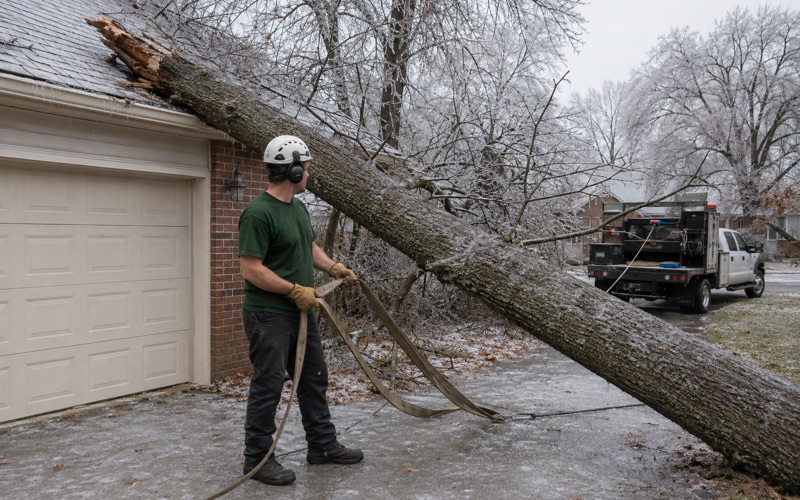
The storm of January 24 and 25, 2026 is the reference event for this ground. Accretion ran from a glaze to more than half an inch, with a quarter to a half inch typical; as many as 230,000 Nashville-area households lost power, and more than 37,000 were still out on February 1. Radnor Lake closed with more than seven miles of trail blocked by downed trees and debris, and Bokor Heights near the park was dealing with fallen trees and dangling lines at the same time.
Ice loading, not wind, is the mode this terrain is exposed to, and it selects differently. It finds long horizontal limbs, co-dominant stems joined by included bark, and evergreen foliage that holds the load — eastern redcedar earns its share of our winter calls. We prune to ANSI A300 standards and we stand down for weather the way ANSI Z133 requires; nobody should be promising to climb in an ice storm.
What we look at before we recommend taking a tree down
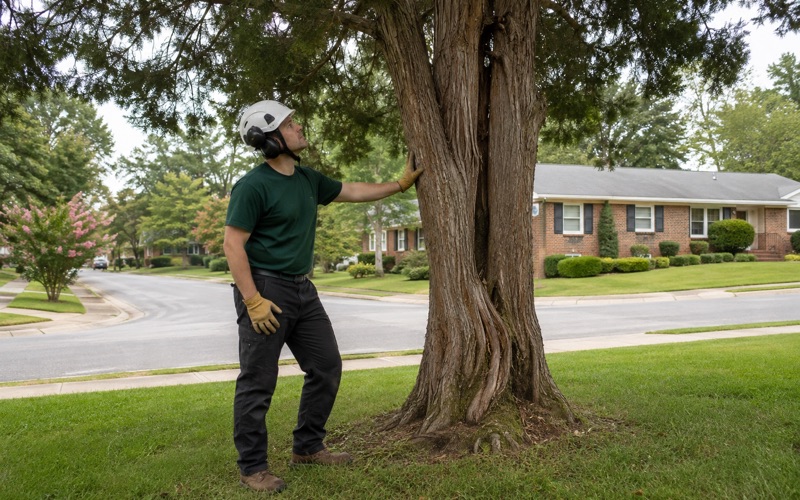
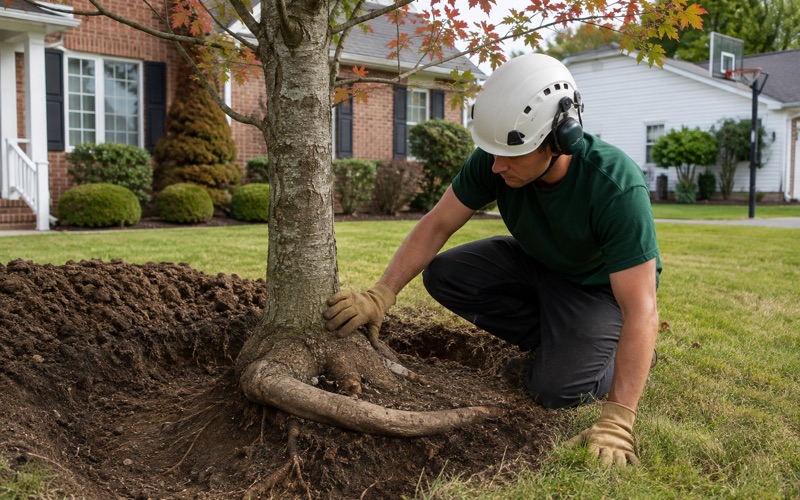
Not every leaning tree here is a hazard, and not every upright one is sound. We look for conk at the root flare, epicormic sprouts along a stressed stem, included bark in a co-dominant union, and soil lifting on the uphill side of a root plate. Where the root collar is buried we excavate it with an air spade before making a call, because a girdling root and a decayed flare look identical from six feet away.
Where a tree can be kept, dynamic cabling or static bracing is often the honest recommendation instead of a removal. Where it cannot, the reasoning goes into a written hazard assessment a homeowner can put in front of a neighbor, an HOA or an insurance adjuster. We will also tell you plainly what a homeowners policy is likely to cover, before a claim is filed rather than after.
Lines, access and the approvals that set your date
The fifteen-foot horseshoe
Nashville Electric Service changed its clearance standard after that storm, and the current state of it is easy to get wrong. NES went from ten feet of clearance below the lines to fifteen feet, applied to all tree species and cut in a horseshoe pattern, and it stopped ground-to-sky trimming, leaving lower vegetation and limbs in place where possible. Metro Council passed a resolution urging NES to pause the blanket fifteen-foot rule; NES declined at its board meeting, saying the risk from overgrown trees ahead of severe weather season outweighed the frustration over the work.
The council asked for a pause and did not get one, so anyone planning work near a distribution line should assume the fifteen-foot standard is live. NES reported trimming 587 miles of vegetation between July and December 2025, in areas it said had gone four years without maintenance. When a line is involved in a storm-damaged tree, we call the utility first and stage our work behind theirs rather than around it.
Getting a machine to the tree
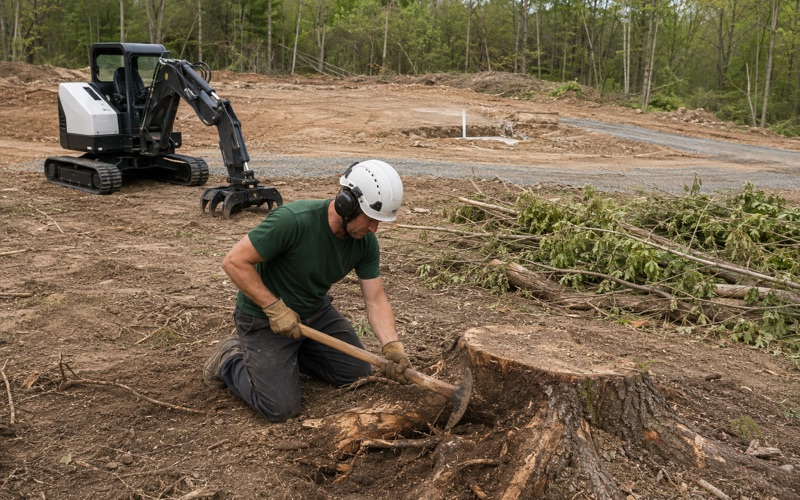
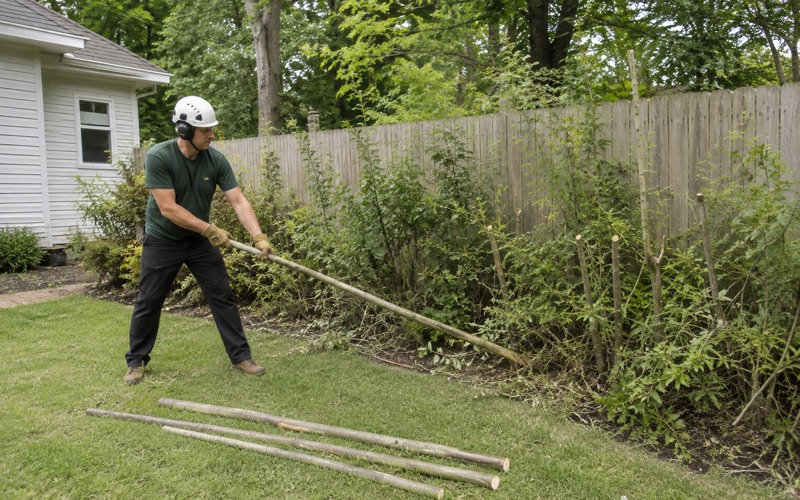
On a hillside lot the equipment list is decided by the driveway, not by the tree. We price access as its own line: gate width, carry distance to the truck, whether a chipper can reach the tree at all, and whether wet ground on a grade will hold a machine. A tracked spider lift and a mini skid steer reach back yards a bucket truck cannot, and property protection mats keep turf and a driveway intact on the way in.
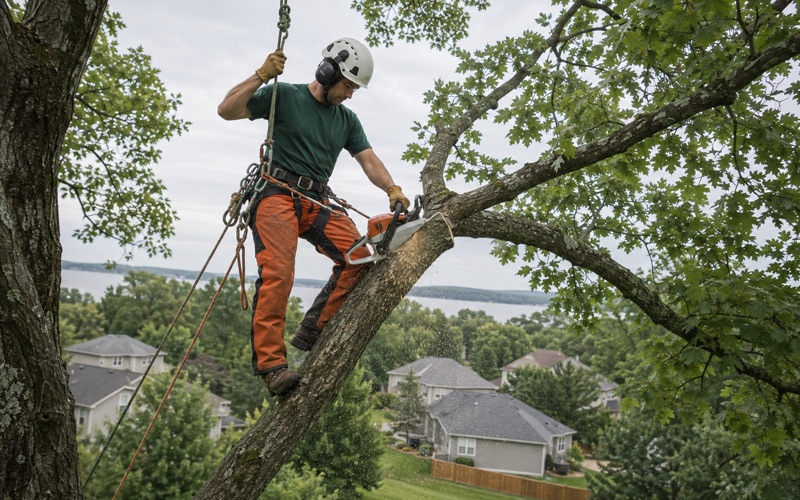
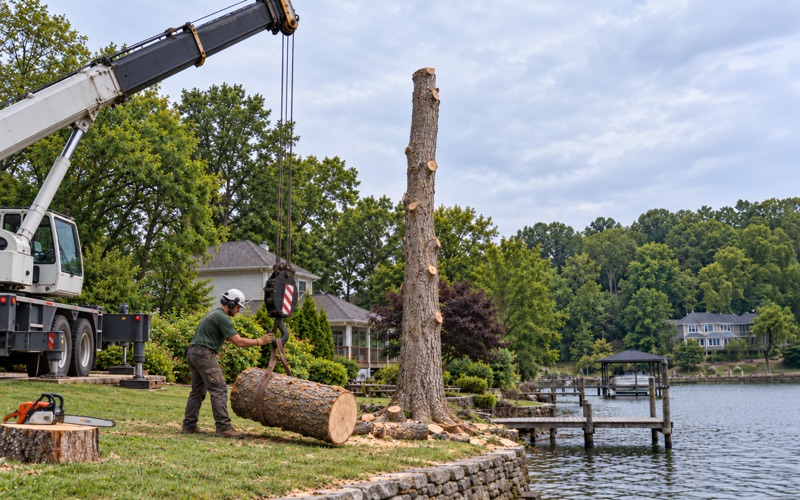
Where a canopy is mature enough that nothing can simply be dropped, a crane, or a rigging block and lowering device, takes the weight instead — and green log weight, not how a limb looks from the ground, is what sizes that decision. Everything cut leaves with us. The city’s complimentary monthly pickup is sized for typical yard waste, limbs and shrubbery pruning with no roots or dirt, not for the trunk rounds off a takedown.
The review step worth knowing about early
On the steep ground there is an approval that can set your start date. Existing vegetation on slopes of fifteen percent or greater is not removed here except as approved by the city’s planning commission, so a hillside removal that is not emergency storm work can wait on that review. We would rather raise it at the estimate than on the morning the crew arrives.
One more thing worth asking of any company working on your property. Tennessee has no trade-specific tree-care or arborist license, so the license question here is a contractor question: Davidson County adopted the state’s Home Improvement license, which covers residential work from $3,000 to $24,999, and a state contractor license is required at $25,000 and above. Ask which band your job falls in, and what the company holds.
- 20+ Years in Middle Tennessee
- Free Written Estimates
- Emergency Storm Response