
Hendersonville TN Tree Removal handles shrub, hedge and brush removal throughout Hendersonville and the surrounding Sumner County area, with more than 20 years of clearing overgrown beds, boundary lines and neglected corners in Middle Tennessee. It is the least glamorous work we do and it is the work that most often makes a property usable again.
Brush jobs go wrong in one predictable way: somebody prices the cutting and nobody prices the debris. A hedge that took fifteen years to grow produces an astonishing volume of material in an afternoon, the city will not collect any of it once a contractor has touched it, and disposal is weighed at the gate rather than waved through. So the haul-away is on our estimate as its own number.
The second thing worth saying up front is that cutting is not always the answer. Some hedges can be renovated rather than removed, some fence lines only need the woody material out, and some thickets will simply come back next season unless the root balls come out with them. We say which case yours is before quoting the machine time.
What Brush Work Actually Covers
Overgrown Shrub Beds and Foundation Plantings
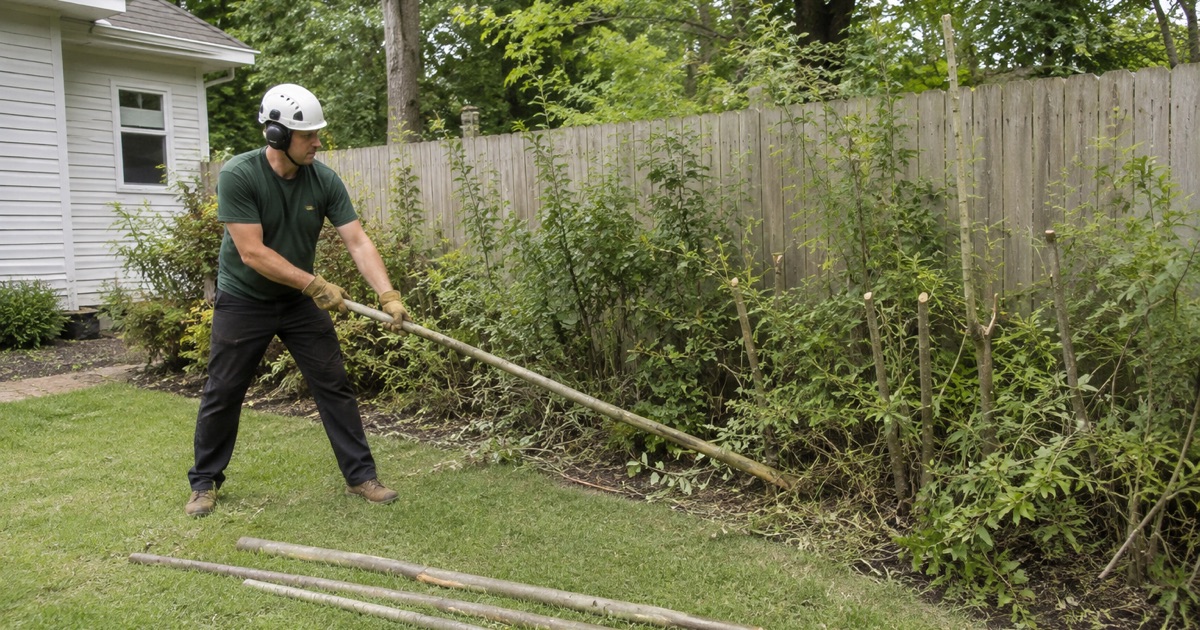
Foundation shrubs planted at nursery size and left alone reach the eaves, block windows, hold moisture against siding and hide everything happening behind them. Removing them is straightforward; the care is in getting the root balls out without disturbing footings, downspout drains or the irrigation heads that were installed around them years later.
Hedge Removal Against Hedge Renovation
A hedge that has gone woody and hollow in the middle is not always finished. Species that regenerate from old wood can be cut hard over two or three seasons and come back dense. Species that cannot — most conifer screens among them — have no such path, and cutting into bare wood leaves a permanent hole. Knowing which is which is the whole decision.
Fence Lines and Property Edges
A boundary left alone for a decade is rarely uniform brush. It is volunteer trees, vine mats heavy enough to pull wire, and occasionally a fence nobody has seen in years. We clear to an agreed line rather than to wherever the vegetation stops, flag anything rooted on the neighbor’s side, and tell you what condition the fence is in before you budget to repair it.
The Plants We Meet Most Often Here
Volunteer Callery Pear
Callery pear seeds itself into fence lines and unmowed edges across Middle Tennessee, grows fast, and arms itself with thorns that flatten tires. Cutting it at grade guarantees a thicket of sprouts, so it is a grubbing job rather than a cutting job wherever the goal is to be rid of it rather than to tidy it up for a season.
Honeysuckle and Privet Thickets
Bush honeysuckle and privet form the dense understory that turns a wooded back lot into something impassable, and both resprout enthusiastically from cut stems. They also shade out everything trying to regenerate underneath. Clearing them opens sight lines and gives desirable trees room, but it is only durable when the crowns come out of the ground.
Leyland Cypress and the Overgrown Screen
Leyland cypress is planted as a fast privacy screen at spacing meant for a shrub, and fifteen years later it is a row of leaning, thin-barked trees shading one another out from the inside. Nothing prunes that back into shape. Realistic options are removing alternate trees to give the rest room, or taking the row out and replanting on spacing that works, and we price both.
Disposal, and Why It Is Its Own Line
The City Program and Where It Stops
Municipal limb and brush collection exists for material residents cut themselves, and it says outright that a homeowner who hires a tree service should have that service haul the debris off. Even for a do-it-yourself pile the rules are strict: nothing thicker than 18 inches or longer than 8 feet, no pile bigger than ten by ten feet, no vines and no root balls.
Chipping On Site Against Hauling Out
A whole-tree chipper turns most brush into a fraction of its original volume, and those chips can stay on the property as mulch if you want them. That is the cheapest outcome available and often the best one for beds and paths. Where there is nowhere to put them, or where the material is thorny or vine-laden, it all goes on the truck instead.
Tipping Is Weighed, Not Waved Through
Disposal costs money at the scale: the Sumner County Resource Authority takes brush and wood at $45 per ton with a $10 minimum, and root balls carry a heavier construction rate on nearby fee schedules. That is why grubbing costs more than cutting, and why any estimate that folds disposal into a round number is hiding the most variable part of the job.
Doing It Without Wrecking the Yard
Turf, Irrigation and Access Routes
The damage on a brush job usually comes from the route rather than the work. We pick an approach, lay property protection mats where the ground is soft, and use a mini skid steer instead of anything heavier when turf matters. Sprinkler heads and low-voltage lighting get located first, because both live exactly where the beds are.
Poison Ivy, Wasps and Other Things We Warn You About
Overgrown brush hides hazards worth knowing about before the crew arrives: poison ivy through the vine mat, ground nests in the leaf litter, and the occasional snake in a rock pile. None of it stops the work, all of it changes how the work is done, and we would rather point it out than surprise you with an invoice line about it afterward.
What We Check Before Anything Is Cut
The five-minute walk before the saws start is what prevents the expensive mistakes. We confirm the boundary, look for the meter, the septic lids and the well head, check cut trunks for spotted lanternfly egg masses, and identify anything you might actually want kept. Plenty of overgrown beds contain one good plant that nobody realized was in there.
- 20+ Years in Middle Tennessee
- Free Written Estimates
- Emergency Storm Response