
Hendersonville TN Tree Removal handles tree trimming and pruning across Hendersonville, TN, serving surrounding cities including Mount Juliet, Oak Hill, La Vergne, Forest Hills and Brentwood. Two decades of climbing here means the crew knows which species tolerate which cuts on this ground, and it is also why we turn down about as much pruning as we sell.
Every job starts with an objective rather than a price per hour. Clearing a roof, taking weight off a limb over a driveway, lifting a canopy for mower access, opening a view corridor and restoring a storm-damaged crown are five different specifications, and the cuts that serve one can be wrong for another. We write down the objective and prune to it under ANSI A300, which is what makes the work reviewable afterward.
The boundaries are just as important. We do not top, we do not lion-tail a canopy to make it look tidy, and we stop for weather the way ANSI Z133 requires rather than promising to work a crown that is still shedding ice. Those limits cost us occasional jobs and they are the reason the trees we prune are still standing.
The Four ANSI A300 Operations, and When Each Applies
Crown Cleaning
Cleaning removes dead, dying, diseased, detached and broken branches, and nothing else. It is the highest-value hour available in most mature canopies because it takes away exactly the wood most likely to fall while leaving the living structure untouched. On a big oak or hickory over a patio, cleaning alone often solves the entire problem the homeowner called about.
Crown Raising for Real Clearance
Raising lifts the lower canopy to clear a roofline, a walk, a driveway, a mower deck or a sight line. The discipline is in stopping: strip too many lower limbs and you get a lollipop with all its weight at the top, a thin taper and sunscald on newly exposed trunk. We raise to a stated height and take it from several points around the tree rather than gutting one side.
Crown Reduction, Done With Reduction Cuts
Reduction shortens a limb or the whole crown by cutting back to a lateral branch large enough to take over as the new terminal. That lateral has to be a meaningful share of the diameter of what is being removed, or the cut behaves like a topping stub. Reduction is what we use over a house, on a limb with a defect, and anywhere a tree has simply outgrown its position.
Crown Thinning, Used Sparingly
Thinning removes selected live branches to reduce density and let wind through. It is the operation most often oversold, because a canopy stripped of interior growth loses the branches that shade and feed the trunk and responds with weak sprouts. Where thinning is genuinely indicated we take a modest percentage from throughout the crown and leave the interior alone.
Pruning Around Roofs, Structures and Power Lines
Roof and Gutter Clearance, and the Non-Renewal Letter
Carriers increasingly write to homeowners about limbs resting on a roof, and that letter converts a preference into a deadline with a specified distance on it. Clearance pruning done properly is a set of reduction cuts back into the canopy, not a flat cut along an imaginary plane above the shingles. We prune to the distance the letter asks for and document the result.
Service Drops and Which Utility Serves You
The overhead wire from the pole to the house is the one people prune into without thinking. Which provider owns it matters here, because Nashville Electric Service and Cumberland Electric both serve this city under different rules and the city owns neither. We confirm the provider, arrange a disconnect or a service-order drop where one is needed, and keep the crew clear of anything still energized.
Chimneys, Solar Arrays and Upper-Story Windows
A limb that is merely close to a chimney flue, a solar array or a bedroom window is a different job from one that is merely close to the lawn, because the consequence of a dropped piece changes. Those cuts get rigged and lowered rather than dropped, and a tracked spider lift often earns its cost by putting the sawyer where the limb can be controlled from above.
Structural Pruning and Support Systems
Young Trees: Fixing Co-Dominant Leaders Early
The cheapest structural work available is subordinating a competing leader on a tree that is still small. Two stems of equal size growing into a tight union with included bark become the split that ice finds in twenty years; a single reduction cut now, on a limb the diameter of a thumb, prevents it. This is the pruning nobody calls about and the one that pays the most.
Mature Trees: Reducing Load Over a Target
On a mature tree with a defect, the realistic goal is lowering the load on the defective part rather than curing it. Shortening an over-extended limb reduces the leverage it applies to a weak union, and taking a few feet off an end-heavy scaffold changes how it behaves in wind. That is a targeted set of cuts specified against a defect, not a general trim.
Dynamic Cabling and Static Bracing
Where the geometry cannot be pruned into safety, a support system can extend a valuable tree’s life. Dynamic cabling allows movement while limiting the extremes; static bracing installs through-rods to hold a split union rigid. Both are supplements to reduction pruning rather than replacements for it, both need re-inspection on a schedule, and neither is appropriate where the underlying problem is decay in the trunk.
Species, Deadwood and Timing on Local Ground
Deadwooding Mature Oak, Hickory and Tulip Poplar
Deadwood is a target problem rather than a health problem — the tree has already abandoned those branches. Shagbark hickory holds its dead limbs stubbornly, tulip poplar drops large ones from considerable height, and both are common enough in older Hendersonville yards to make a cleaning visit worthwhile before a party rather than after a storm.
Leyland Cypress and the Overplanted Screen
Leyland cypress is sold as a fast screen and planted at spacing meant for a shrub, and fifteen years on it is a leaning row shading itself out from the inside. It will not regenerate from cuts into old wood, so there is no pruning that restores one. The honest options are selective removal to give the survivors room, or replacement on realistic spacing, and we lay out both with prices.
When to Prune, and When to Wait
Dormant-season work gives the clearest view of structure and the fastest wound response in spring. Deadwood and hazard work do not wait for a calendar. Where a tree is already stressed — recent construction damage, a root zone that has been compacted, a canopy thinning from the top down — the right answer is often to treat the cause first and prune the following year.
Our Step-by-Step Tree Trimming Process
1. Agree the Objective in Plain Words
Before any specification we establish what you actually want changed: the roof clear by a stated distance, the driveway usable by a box truck, the dead wood out over the patio, the view opened toward the water. Everything downstream is derived from that sentence, and a job with no such sentence is how over-pruning happens.
2. Specify the Cuts, Not the Hours
We convert the objective into operations — clean, raise to a height, reduce a named limb, thin a stated share — and write them on the estimate. That is what the climber works from, what you can hold us to, and what makes two competing quotes comparable instead of two different numbers for the word “trim.”
3. Climb, Lift or Bucket, Depending on the Tree
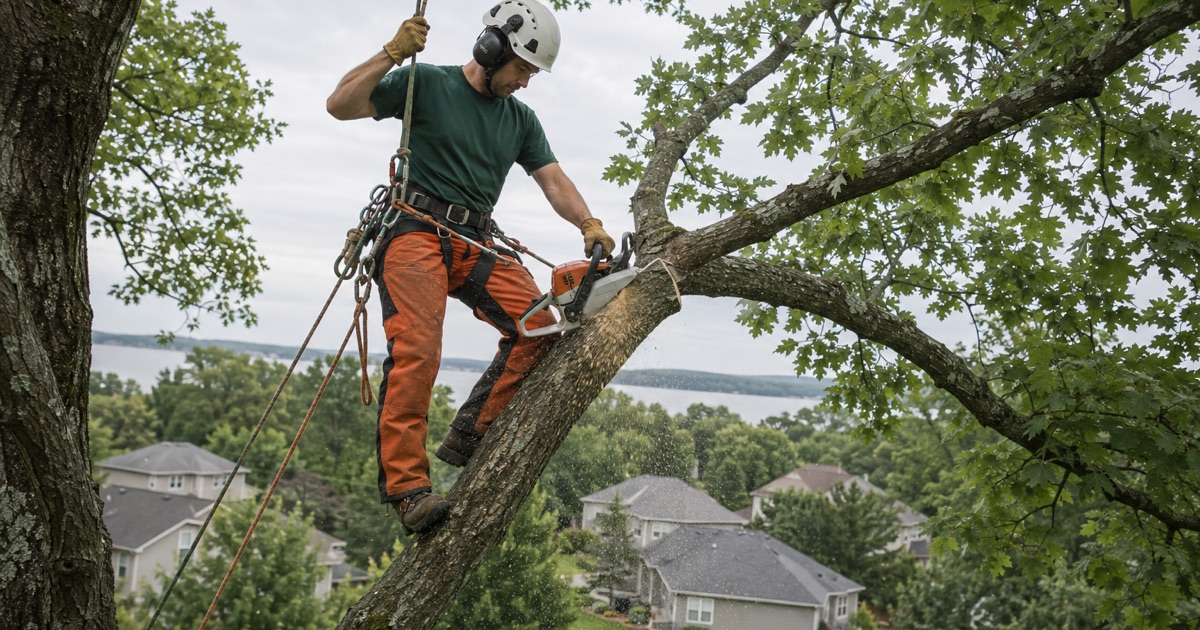
Access is chosen for the tree rather than for the crew’s convenience. A bucket is quick where the drive reaches; a tracked spider lift crosses turf on mats where it does not; and some canopies are still best worked on a climbing line, which reaches the interior positions a boom cannot. Rigging comes out whenever a piece cannot simply be dropped.
4. Clean Up, and Tell You What We Found
Brush goes through the chipper, the lawn and the gutters get blown clear, and cut ends get checked against the specification. Then you hear what the crew saw from up there — a decay pocket, a crack in a union, a cavity that is not visible from the ground — because the best view of a tree’s structure is from inside it, and that information is worth as much as the pruning.
- 20+ Years in Middle Tennessee
- Free Written Estimates
- Emergency Storm Response